
Commodities
Gold’s appeal persists amid geopolitical jitters and tariffs uncertainty

Gold prices maintain their bullish momentum as US President Trump threatens unilateral tariffs, while lower confidence in a nuclear deal with Iran fuels geopolitical fears. Lingering US dollar weakness and continued central bank buying add to the tailwinds.

XAU/USD Analysis
Geopolitical uncertainty is rising after the US President expressed diminished confidence in reaching a nuclear deal with Iran. He stated he is now “much less confident” about such an outcome, according to his remarks on the Pod Force One podcast [1]. President Trump also confirmed that US personnel are being withdrawn from the Middle East, describing the region as “potentially dangerous”. [2]
Meanwhile, trade anxiety remains elevated, with President Trump threatening to impose unilateral tariffs. He indicated that the administration will be sending letters in “about a week and a half - two weeks” to trading partners, “telling them what the deal is”. [3]
Against this challenging and uncertain backdrop, investors continue to seek refuge in gold. Central bank buying also remains strong, with the People’s Bank of China (PBoC) increasing its gold reserves for a seventh consecutive month in May [4]. The precious metal’s demand was underscored by an ECB analysis, which revealed it had become the second-largest reserve asset in 2024, overtaking the euro [5]. Ongoing US dollar weakness, which has become a casualty of Trump’s disruptive trade policies, further supports bullion prices.
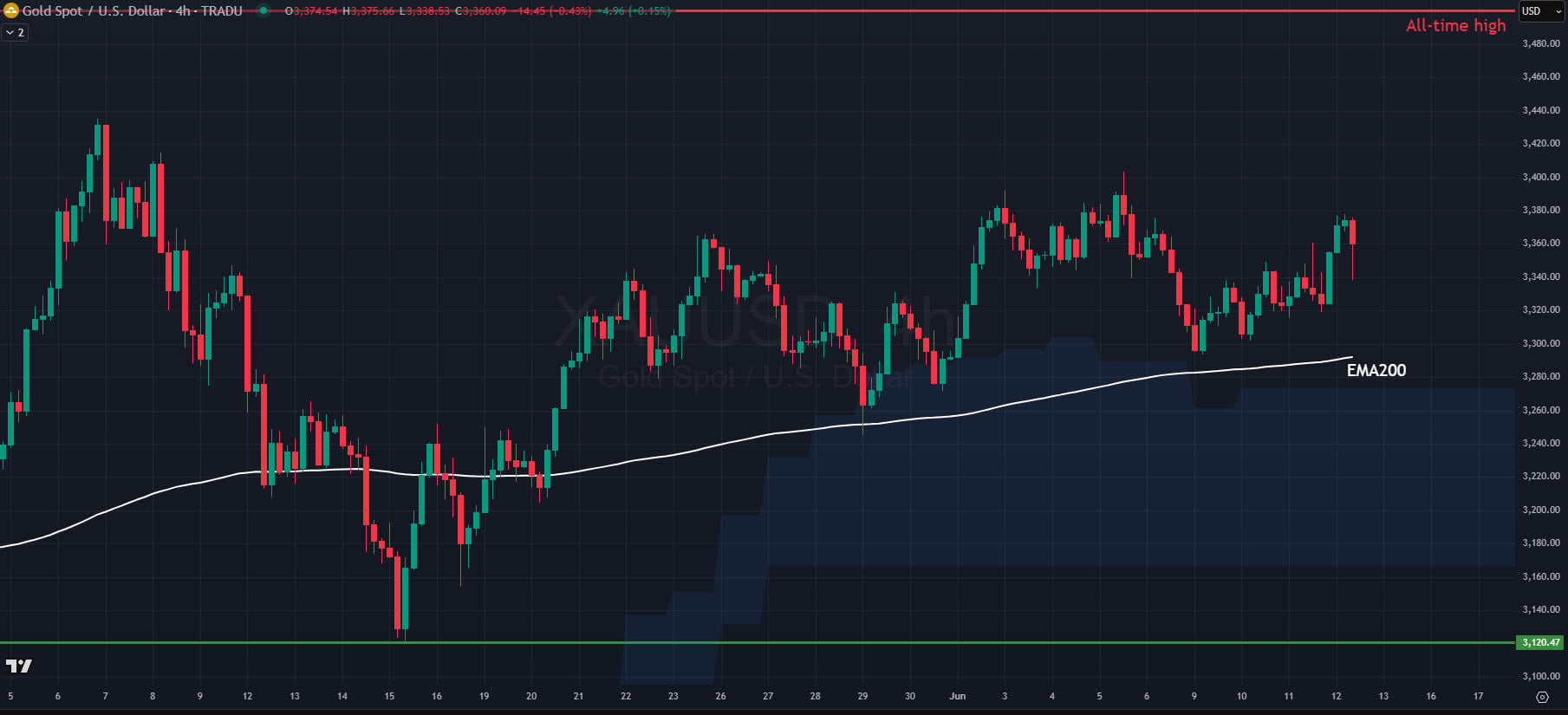
XAU/USD pushes for a profitable week after having defended the EMA200, reaffirming its upside bias. With geopolitical and trade uncertainty persisting, the road remains open for new all-time highs (3,500.17).
Source: www.tradingview.com
However, gold’s rally shows signs exhaustion in recent weeks. Although prolonged weakness is not easy in the current risk environment, XAU/USD is vulnerable to pullbacks. Breach below the EMA200 that would challenge the bullish bias, as trade and geopolitical tensions could ease, curbing its risk-off appeal.
This week, the US and China reached a framework to implement their Geneva agreement, following talks that appeared to rebuild some trust between the world’s two largest economies. Additionally, during a Senate hearing on Wednesday, the US Treasury Secretary signalled a willingness to delay tariffs on countries engaged in negotiations. Secretary Bessent noted that such an outcome is “highly likely” for partners acting “in good faith” [6]. Meanwhile, a US-Iran deal remains possible, with another round of talks expected to take place this week.
Senior Financial Editorial Writer
Nikos Tzabouras
Nikos Tzabouras is a graduate of the Department of International & European Economic Studies at the Athens University of Economics and Business. With extensive experience in market analysis and a strong foundation in international relations, he brings a unique perspective to financial markets. Nikos emphasizes not only technical analysis but also on fundamentals and the growing influence of geopolitics on financial trends.
As a Senior Financial Editorial Writer, he delivers comprehensive and forward-looking insights across a wide range of asset classes, including equities, commodities, and currencies. His work explores how macroeconomic events, political developments, and global policies impact market dynamics, providing readers with a deeper understanding of both short-term movements and long-term trends.