
Forex
EUR/USD rally at risk as President Trump announces 30% tariffs on the EU

US President Trump announced tariffs of 30% on imports from the European Union starting August 1, which could harm the already frail European economy. This would put pressure on the ECB for more rate cuts, threatening this year’s Euro rally. Yet, there is time for negotiations, the EU is looking to increased defence spending to boost growth, and the US Dollar could continue to face headwinds.

European economy at risk from Trump’s tariffs
The US President has picked up his tariffs activity this month as he imposed 50% duties on copper and begun sending letters to trading partners, informing them of the tariffs they will face for access to the US market. As part of this process, he announced levies of 30% on imports from the European Union, starting 1 August, while warning of even higher rates should the EU retaliate. [1]
The United States is the EU’s largest trading partner, accounting for 20.6% of its exports in 2024, worth well over €500 billion [2]. Pharmaceuticals top the export list, and President Trump has recently threatened separate duties of 200% on this sector [3]. Motor vehicles, another leading export, have already been hit with 25% tariffs, as part of Trump’s broader sectoral strategy.
These disruptive trade policies are creating serious headwinds for the already fragile European economy. Although GDP growth accelerated to 0.6% quarter-on-quarter in Q1, that figure remains weak. The World Bank forecasts 0.9% growth for 2025 - far from impressive [4]. Making matters worse, the EU may find itself at a disadvantage compared to countries like the UK, which has secured a bilateral trade deal with the US that ensures lower duties.
Still, both sides have been working toward a trade agreement that might improve conditions. EU Commission President Ursula von der Leyen warned that the bloc would take “all necessary steps” to defend its interests, but also reaffirmed her commitment to negotiations saying “We remain ready to continue working towards an agreement by 1 August.” [5]
The negative effects of Trump’s trade agenda are hitting home as well, raising risks of stagflation, despite resilient labor market. Consumer confidence has taken a hit, GDP shrank 0.5% in the first quarter – the first contraction in three years – while tariffs can exacerbate the already persistent price pressures. Meanwhile, the One Big Beautiful Bill sparked fresh concerns over the ballooning US debt. The Congressional Budget office estimates the legislation to increase deficits by $3.4 trillion over the 2025-2034 period. [6]
Monetary policy implications of Trump’s trade agenda
The European Central Bank has been cutting rates for over a year now to boost economic activity and the new tariffs could create pressure for additional moves. On the other hand, the ECB has already delivered 200 basis points of cumulative cuts, bringing rates into neutral territory - their lowest in nearly three years.
This may limit its capacity or willingness to cut further. Speaking on CNBC, Chief Economist Philip Lane said he believes the easing cycle is “done” with inflation back at targe, although he did warn of possible new shocks [7]. Meanwhile, fiscal support, particularly from Europe’s historic rearmament push, is expected to underpin growth in the medium term. The ECB noted that this spending will “increasingly support growth” [8], with military contractors like Renk already seeing rising revenues and stock prices.
In the US, the Federal Reserve remains cautious as it assesses the impact of Trump’s policies on growth and inflation. With the latest jobs report confirming a strong labour market and inflation still above target, the Fed has little immediate incentive to cut. Still, pressure is mounting, and officials anticipate two rate cuts in 2025, according to their June projections.
What’s next for EUR/USD as tariffs loom
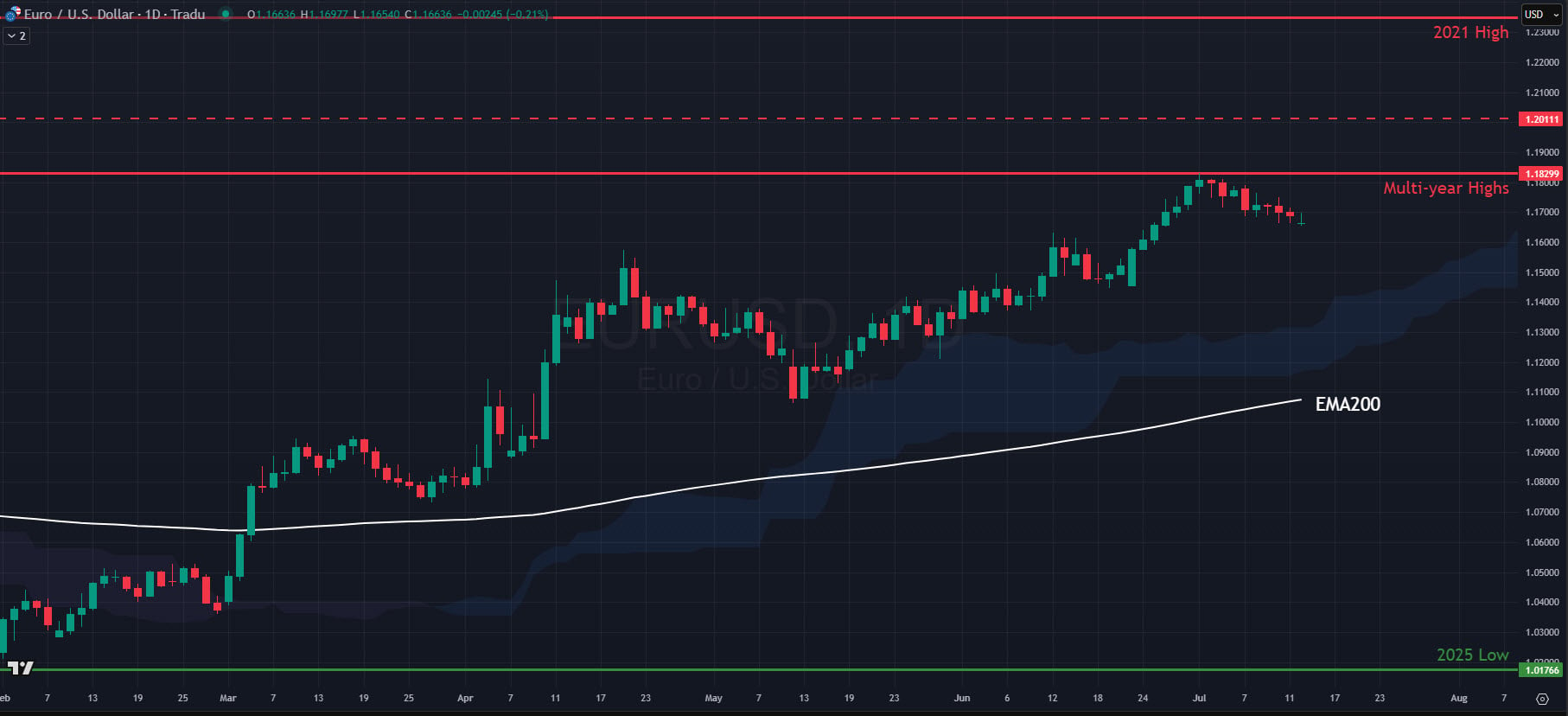
When President Trump returned to the White House at the start of 2025, EUR/USD was falling and risked hitting parity. The rest of the year, however, turned out very differently: the pair has gained over 12% year-to-date, reaching its highest level in nearly four years.
A weaker US dollar, which has become a key casualty of Trump’s disruptive policies, is one of the main drivers. With Europe offering a comparatively stable macroeconomic environment, favourable dynamics could persist and push EUR/USD above 1.2000.
Source: www.tradingview.com
Trade and fiscal uncertainty are eroding the dollar’s safe-haven appeal and reserve status, while concerns over the Fed’s independence add to the pressure. Trump once again called for Chair Powell to step down, saying that would be a “great thing” [9]. Meanwhile, NEC Director Kevin Hassett told ABC’s This Week that Powell’s removal is “being looked into” by the administration. [10]
At the same time, the monetary policy deferential could continue to support the pair. The ECB is close to the end of its cycle – if not already there – whereas the Fed’s expects to cut rates in the second half of the year.
That said, continued macro headwinds could push the ECB into sub-neutral rates, while the Fed remains reluctant to ease amid economic resilience. Additionally, euro strength could weigh on exports, with ECB officials highlighting the risk, according to the minutes of the latest meeting. At the same time, USD pessimism may be reaching its limits, and the greenback is showing signs of recovery this month. These factors could weigh on the pair, potentially triggering a correction back toward the 200-day moving average.
Senior Financial Editorial Writer
Nikos Tzabouras
Nikos Tzabouras is a graduate of the Department of International & European Economic Studies at the Athens University of Economics and Business. With extensive experience in market analysis and a strong foundation in international relations, he brings a unique perspective to financial markets. Nikos emphasizes not only technical analysis but also on fundamentals and the growing influence of geopolitics on financial trends.
As a Senior Financial Editorial Writer, he delivers comprehensive and forward-looking insights across a wide range of asset classes, including equities, commodities, and currencies. His work explores how macroeconomic events, political developments, and global policies impact market dynamics, providing readers with a deeper understanding of both short-term movements and long-term trends.