
Commodities
Copper prices surge as Trump announces 50% Tariff on Imports

US President Trump has announced a 50% tariff on copper imports in a bid to boost domestic production, sending NY copper prices to record highs. The move comes amid a surge in structural demand driven by the AI boom and the clean energy transition - two major forces propelling copper prices higher in 2025. However, Trump's broader trade policies risk triggering a global economic slowdown, which could ultimately weigh on copper consumption and prices.

Trump slaps tariffs on copper, prices surge
US President Donald Trump has announced a 50% tariff on copper imports during a cabinet meeting on Tuesday [1], in a bid to boost domestic production of this critical mineral. Commerce Secretary Lutnick provided further details on the timing, stating on CNBC that the levies are “likely to be put into place at the end of July, maybe August 1.” [2]
The announcement triggered a sharp surge in Comex copper futures yesterday, pushing them to new all-time highs. The move is expected to benefit domestic producers such as Freeport-McMoRan, which anticipates a 5% rise in sales this year [3] and saw its stock gain 2.5% following the news. However, the tariffs could negatively impact these companies' global operations.
Tariffs are a catalyst for copper consumption
Although the size of the duties may have taken markets by surprise, the action itself was largely anticipated. President Trump had launched a probe into copper imports on national security grounds back in February [4], and US officials have repeatedly hinted at such measures since.
In an effort to pre-empt the tariffs, US traders embarked on a copper buying spree - a key driver of this year’s copper rally. As noted in our recent copper outlook, such dislocations can tighten the market and support higher prices. However, with the tariffs now official, that surge in demand may subside, potentially removing a major price driver.
The United States produced an estimated 850 tonnes of primary copper in 2024, according to the US Geological Survey, yet this covered only a part of its consumption” [5]. As a result, the US will still need to import significant quantities of copper - now at a considerably higher cost.
Moreover, Trump’s broader trade agenda could contribute to a global economic slowdown. The World Bank recently cut its 2025 global growth forecast by 0.4%, citing “increased trade tension and heightened policy uncertainty” [6]. A weaker global economy could weigh on copper demand - a metal used in everything from construction and transportation to consumer electronics.
AI and clean energy drive structural demand
The non-ferrous metal is essential in the production of semiconductors and data centres, sectors experiencing rapid growth due to the rise of artificial intelligence and ongoing investment by Big Tech. Illustrating this trend, Meta Platforms is targeting $64–72 billion in capital expenditures this year - a jump of at least 63% compared to 2024. Chinese tech giants such as Alibaba are also scaling up spending. However, continued investment growth is not guaranteed, given the uncertain macroeconomic climate and ongoing debate over AI’s actual productivity gains.
The green economy provides another strong source of copper demand. The metal is critical for electric vehicles, solar panels, wind farms, and associated infrastructure. According to the International Energy Agency (IEA), copper demand is expected to increase by 17.3% by 2030, with clean technologies accounting for a third of that growth [7]. Nonetheless, the transition to net zero faces headwinds, especially in the US, where President Trump is actively rolling back clean energy incentives.
What’s next for copper prices after Trump tariffs
The tariff announcement pushed copper prices to record highs, taking year-to-date gains to over 40%. Tight supply following the US buying spree, coupled with long-term demand from AI and clean energy, could support continued strength and open the door to the $6,000 mark.
That said, the recent spike in US demand may taper off once the 50% duty on imports is imposed. Additionally, Trump’s tariff policies threaten the global economy and risk dampening copper consumption and prices. On the technical front, the Relative Strength Index points to highly overbought conditions, which can contain the upside and lead to corrections.
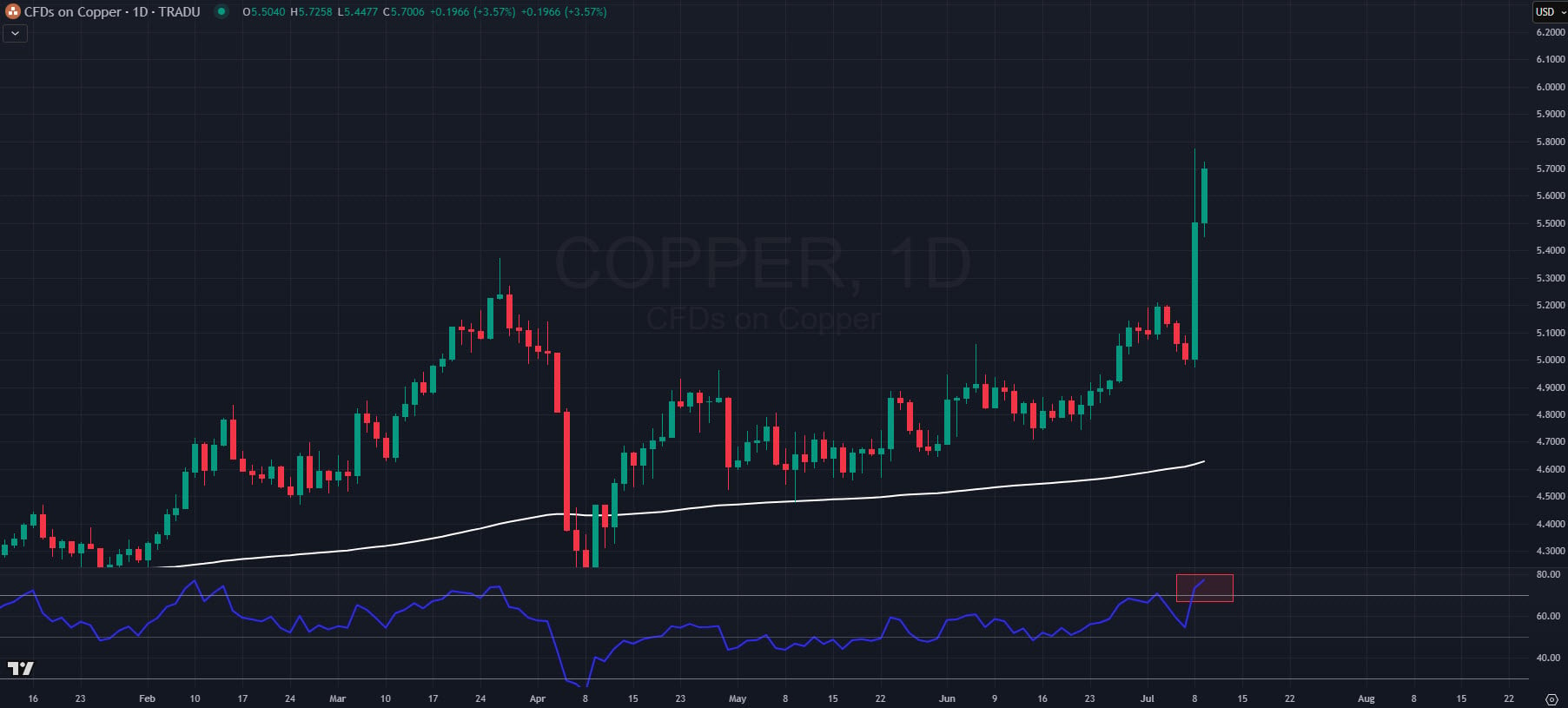
Source: www.tradingview.com
Senior Financial Editorial Writer
Nikos Tzabouras
Nikos Tzabouras is a graduate of the Department of International & European Economic Studies at the Athens University of Economics and Business. With extensive experience in market analysis and a strong foundation in international relations, he brings a unique perspective to financial markets. Nikos emphasizes not only technical analysis but also on fundamentals and the growing influence of geopolitics on financial trends.
As a Senior Financial Editorial Writer, he delivers comprehensive and forward-looking insights across a wide range of asset classes, including equities, commodities, and currencies. His work explores how macroeconomic events, political developments, and global policies impact market dynamics, providing readers with a deeper understanding of both short-term movements and long-term trends.