
Shares
Tesla concerns linger after poor results, but Elon Musk promises more time and autonomous driving

Tesla reported steep declines in revenues, operating margin, and deliveries for Q2 2025, but Elon Musk promised to spend more time on the company, while reiterating his commitment to the robotaxi rollout and humanoids.

Tesla’s EV appeal weakens amid rising competition
The proliferation of electric vehicles (EVs) slowed last year amid a challenging macroeconomic environment. Persistent inflation across much of the world is squeezing disposable incomes, elevated interest rates are making financing for the typically more expensive EVs even costlier, and economic uncertainty is deterring big-ticket purchases such as cars. The disruptive trade policies of US President Trump and his pledge to revoke the electric vehicle mandate [1] could further exacerbate these headwinds.
Beyond these broader challenges, Tesla faces its own specific issues. Even though the Model Y remains a global best-seller, Tesla’s line-up is limited and ageing - just as competition intensifies, especially in China. Furthermore, concerns are mounting over Elon Musk’s public image and the brand’s appeal, due to his political involvement and leadership of the Department of Government Efficiency (DOGE). CNBC’s All-America Survey found that 47% of the public now view the company negatively [2], while YouGov’s quarterly tracker also shows a decline in popularity this quarter [3].
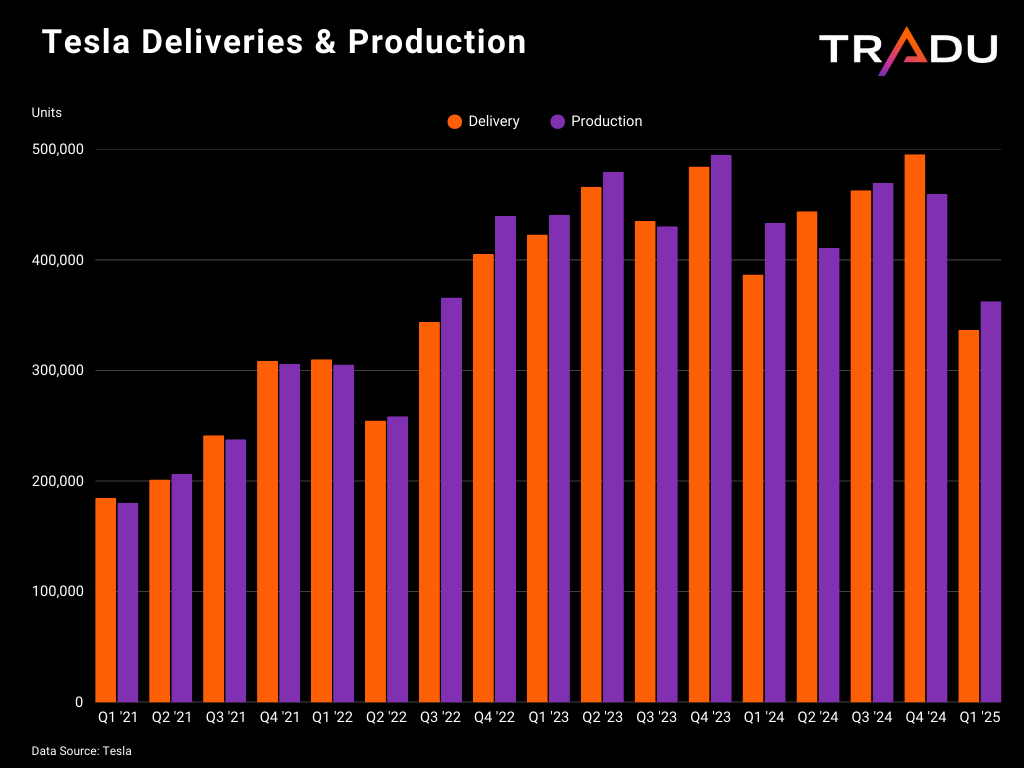
Vehicle deliveries fell 13% year-on-year in the first quarter [4] to 336,681 - the lowest level in nearly three years - while inventories surged again to 22 days of supply. Notably, the company refrained from issuing any growth volume guidance, opting instead to revisit its target in the second-quarter update. Although industry-wide challenges and transitional factors, such as the update to the Model Y, played a role in the weak results, concerns about deeper structural demand issues persist.
Q1 financial results reveal major setbacks
To mitigate weak demand, the EV maker continued to offer sales incentives, but that is a bad combination for its top and bottom lines. Automotive revenues plunged 20% year-on-year, while total revenues dropped to $19.335 billion - the lowest since 2022. Operating profits tumbled to just $399 million, and operating margin, at 2.1%, was the narrowest in over five years.

However, Tesla continued to benefit from emissions credit sales, which provided a lifeline for revenues and profitability. Its Energy division remained a bright spot, with energy storage deployments more than doubling and revenue jumping 67% year-on-year. Still, with tariffs posing a significant risk to that segment, doubts are emerging about the sustainability of this performance.
Tesla’s strategy: Affordable EVs, autonomous driving, and humanoids
Like many other automakers, Tesla is banking on more affordable vehicles to reinvigorate demand in the face of economic headwinds. The company reiterated its intention to begin production of lower-cost models within the current quarter. However, details remain vague, and it appears Tesla may simply offer stripped-down versions of existing models rather than launching entirely new vehicles. Tesla VP of Vehicle Engineering, Lars Moravy, seemed to confirm this strategy on the earnings call, noting that upcoming models will “resemble, in form and shape, the cars we currently make”. [5]
Furthermore, Tesla is lagging in this push towards lower-cost models. Chinese rivals such as BYD offer broad line-ups with low entry prices that Tesla cannot currently match. European legacy automakers are also making strides, with Renault and Fiat (of Stellantis) leading the charge in affordable BEVs with the R5 and Panda models.
Still, Tesla aims to be more than just an automaker. Elon Musk is steering the company toward a high-stakes pivot to autonomous driving and humanoid robots that can unlock tremendous value. During the earnings call the CEO reiterated his conviction that the firm’s future lays in these initiatives. The purpose-built Cybercab is scheduled to enter volume production in 2026, but the first test of Tesla’s autonomous ambitions comes in June, with a planned rollout of unsupervised autonomy in Austin, before wider expansion. As for humanoid robots, Musk claims “thousands” of Optimus units will be operational in Tesla factories by year-end, though mass production and broader availability remain further off.
Elon Musk’s distractions and their impact on Tesla stock
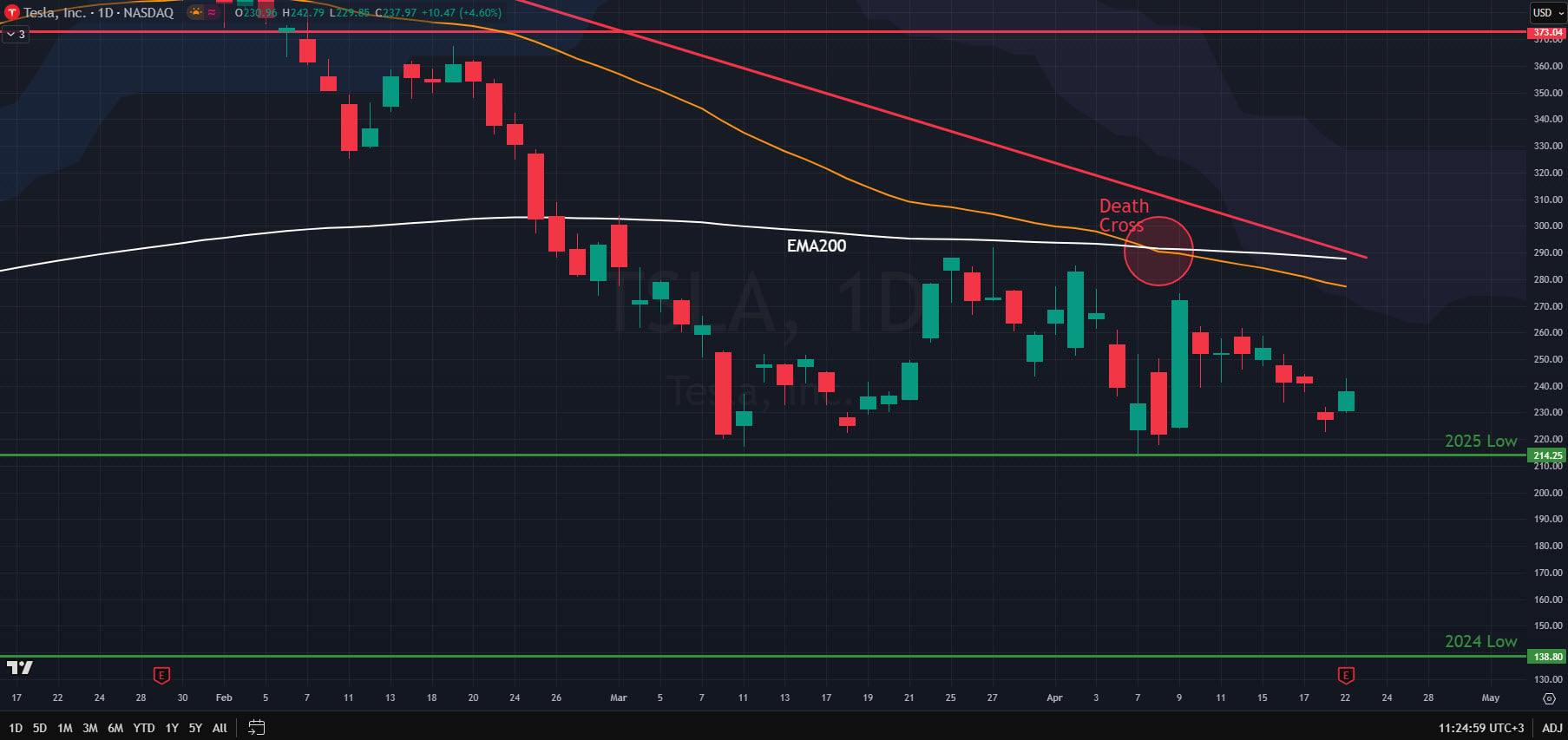
Tesla shares have lost over 40% of their value this year, weighed down by faltering automotive performance, increasing competition, and deteriorating financials. Wall Street sentiment has soured further due to Musk’s work with DOGE, which is seen as a distraction from his core responsibilities at Tesla. The CEO acknowledged this in a recent Fox interview, admitting that he is running his companies with “great difficulty” [6].
However, Musk has now pledged to spend “significantly” less time on DOGE going forward - a move that could help Tesla navigate current headwinds and regain investor trust. He remained upbeat about the company’s long-term prospects, citing strategic progress despite “a few bumps along the road.”
The news can help TSLA rebound but significant challenges remain before the bearish trend can be reversed. The technical outlook looks heavy for TSLA as a Death Cross (EMA50 < EMA200) has formed on the daily cross, which is often viewed as precursor of sustained weakness.
Source: www.tradingview.com
Tesla at crossroads amid increasing competition and AI pivot
Tesla’s core automotive business is faltering just as global competition is intensifying. Chinese manufacturers are difficult to beat on price, and European carmakers are bringing affordable EVs to market. Tesla leadership is under threat, with BYD selling more battery electric vehicles (BEVs) in the first quarter [7], while showcasing remarkable technological prowess. It aims to popularize autonomous driving by embedding such capabilities in most of its cars [8], and is addressing range anxiety with breakthrough five-minute charging technology [9].
While Tesla has bold ambitions in autonomous driving, competitors like Waymo are further ahead. Regulatory approval hurdles, which Musk tends to downplay, may also delay progress. Similarly, Tesla is not alone in pursuing humanoid robotics—firms like XPeng are making strides as well. Elon Musk’s political affiliations and DOGE involvement also risk damaging Tesla’s brand.
However, his affiliation with President Trump can prove a masterstroke. The Department of Energy Efficiency and Trump’s push for lighter regulations could facilitate Tesla’s unassisted autonomy ambitions, while his trade policies may disproportionately hurt rivals. Tesla’s localised supply chains and domestic production could offer some insulation against tariffs.
Tesla stands at a pivotal moment. Its automotive business is under strain, and the promise of an AI-driven future remains just that for now. Realising this vision will require flawless execution, and the journey ahead may still be turbulent.
Senior Financial Editorial Writer
Nikos Tzabouras
Nikos Tzabouras is a graduate of the Department of International & European Economic Studies at the Athens University of Economics and Business. With extensive experience in market analysis and a strong foundation in international relations, he brings a unique perspective to financial markets. Nikos emphasizes not only technical analysis but also on fundamentals and the growing influence of geopolitics on financial trends.
As a Senior Financial Editorial Writer, he delivers comprehensive and forward-looking insights across a wide range of asset classes, including equities, commodities, and currencies. His work explores how macroeconomic events, political developments, and global policies impact market dynamics, providing readers with a deeper understanding of both short-term movements and long-term trends.