
Trump trade wars begin with a twist
The 47th President of the United States started his tenure cautiously regarding a key campaign promise - tariffs. Despite this initial reticence, he made his opening salvo over the weekend with levies on imports from key trading partners. However, he later postponed the implementation of some of these measures, adding a twist to an already volatile and uncertain situation.
In particular, President Trump imposed blanket tariffs of 10% on Chinese goods, prompting Beijing to retaliate, thus marking the beginning of a new era of trade wars. The country’s Finance Ministry announced[1] a 15% levy on coal and liquefied natural gas (LNG), along with a 10% duty on crude oil and other products, set to take effect on 10 February. Additionally, Beijing imposed export restrictions[2] on critical minerals like tungsten, and launched anti-monopoly probe[3] against Google.
The US President had also announced[4] 25% tariffs on imports from Mexico and Canada, with energy products from the latter subject to a lower 10% levy. However, he later paused[5] the action against Mexico for one month while key members of his administration engage in negotiations with the southern neighbour. He also suspended[6] action against Canada for the same period to assess “whether or not a final economic deal” could be reached.
Tariffs a tactical move, not the end game
The temporary pause suggests that President Trump views tariffs as a negotiating tool rather than an end in themselves, as part of a broader strategy to secure more advantageous economic and trade agreements with key partners. The involvement of his Secretary of State and Secretary of Commerce in the Mexico discussions, as well as references to a final economic deal with Canada, indicate that these tariffs were not primarily about fentanyl or immigration but about a wider trade restructuring. An early renegotiation of the United States-Mexico-Canada Agreement (USMCA) is likely the real objective, as the scheduled 2026 review is not politically favourable for Trump, given the mid-term elections.
It is evident that the US President favours making bold threats to extract concessions from his counterparts. This suggests that his tariff pledges may not be fully implemented or could be less severe than initially feared, potentially resulting in a more subdued economic impact. Even so, his threats and actions will still influence the global economy, while the added uncertainty further complicates the already difficult task facing central banks. Moreover, while Mexico and Canada may have been the low-hanging fruit of Trump’s strategy, negotiations with China and Europe are likely to prove far more challenging.
Tariffs to affect US macroeconomic environment
The prevailing thinking is that the imposition of tariffs in products coming from other countries, will increase the cost for US consumers. The Unites States is the largest goods importer in the world, with the European Union, China, Mexico and Canada being its top suppliers.
Mexico is a major automotive manufacturing hub, with global and US auto giants like Ford and General Motors having plants there. Most of the cars produced in the country are headed[7] to the United States. Canada is also a key vehicle manufacturer, but more crucially is an important oil producer, with more than 60% of US oil imports coming[8] from its northern trade partner.
Amid strong economic growth and already persistent inflation, higher tariffs along with lower taxes and other aspects of Trump’s agenda, could stoke price pressures. Even if his bold threats do not materialize, expectations of higher prices alone can push up inflation, in a self-fulfilling prophecy. On the other hand, there are arguments that any reflationary impact will only be temporary, while others argue that trade wars will primarily impact growth, not inflation.
Monetary policy and US Dollar implications
With Trump’s policies likely to exacerbate persistent inflation, a solid labour market with low unemployment and strong gains, and a robust economy expanding at 2.3% in the fourth quarter, the Federal Reserve lacks a compelling case to ease monetary conditions. After September’s outsized pivot and a cumulative easing of 100 basis points in 2024, policymakers have become hesitant. They paused[9] in January, removed any dovish language from the policy statement, and Chair Powell stressed that officials “do not need to be in a hurry to adjust” their stance, while their most recent projections indicate[10] just 50 basis points of rate cuts this year.
The US Dollar revels against this backdrop, gaining over 2% since the US elections, with prospects of elevated inflation and limited easing providing scope for further strength. However, there remains significant uncertainty surrounding tariffs, as highlighted by the pause in actions against Mexico and Canada, as well as their potential impact. Should tariffs lead to reduced domestic consumption and lower economic growth, the Federal Reserve may need to step up easing, which would pressure the greenback. Furthermore, Trump is unlikely to tolerate a much stronger dollar or sour sentiment on Wall Street and could adjust his approach accordingly. In any case, tariffs will have global consequences, as will the trajectory of the dollar.
Canada tariffs on hold, but risk for the Canadian Dollar loom
Although US President Trump announced a 30-day suspension of tariffs against its northern neighbour, the threat remains. The economic impact could be substantial, as most of Canada’s exports, including crude oil, go to the United States. Even if the two sides manage to reach a new trade deal swiftly and avoid tariffs, the Canadian economy could still be left worse off.
The country’s central bank is at the forefront of monetary easing, with six consecutive rate cuts, amounting to 100 basis points. As a result, officials adopted[11] a less dovish stance after the last move in January. They expect stronger GDP growth of 1.8% this year and inflation around 2%, but that forecast is based on “setting aside threatened US tariffs.” Further easing remains on the table, especially if tariffs are imposed and affect the economy.
The Bank of Canada’s front-running led USD/CAD to an 8.6% surge last year, while the later-suspended tariffs sent it to the highest levels in nearly twenty-two years. Should the BoC continue cutting to support the economy and the Fed remain cautious, further CAD weakness would follow. On the other hand, the BoC may be nearing the end of its cutting cycle and that could help the Canadian dollar, as could the avoidance of tariffs.

Despite tariff suspension, the Mexican peso remains at risk
As with Canada, Trump postponed the previously announced 25% levy on Mexican imports while the two sides negotiate their differences. However, the US President has criticised Mexico multiple times, and the threat of tariffs is likely to persist. This puts Latin America’s second-largest economy in a tough spot, as growth already slows, with the International Monetary Fund (IMF) forecasting[12] GDP expansion of 1.4% this year (down from 1.8% in 2024).
The Bank of Mexico (Banxico) has delivered five rate cuts of 0.25% each over nearly a year, with pace increasing in recent months to support the economy. Following progress in disinflation, officials adopted[13] a more dovish stance after the last move in December, while noting “uncertainty” stemming from potential US tariffs. They have opened the door to bolder cuts, stating that “larger downward adjustments could be considered” in upcoming meetings, with the next one taking place this Thursday (6 February).
USD/MXN rallied 23% in 2024, and with Banxico’s easing lead over the Fed likely to widen this year, further gains could be in store. The pair reached the highest levels in nearly three years this week. However, the tariff pause led to a pullback showing that the rise may have limits, should cooler heads prevail.

China trade wars pose a problem for the Yuan
Unlike Mexico and Canada, US President Trump did not halt the tariffs imposed on Chinese goods, and Beijing responded with countermeasures of its own. China has been Trump’s biggest target in terms of trade relations, so more actions and/or threats could follow. The United States already has a wide range of levies in place and trade restrictions, especially concerning advanced technologies and semiconductors, amid broader tense Sino-Western relations.
Any escalation of the trade wars would deepen China’s economic struggles and make it harder to channel its overcapacity abroad. Authorities have already implemented fiscal and monetary easing to support economic activity, and further action may be necessary as problems could worsen with the imposition of additional tariffs.
The yuan could face further devaluation in this adverse environment. USD/CNH has gained 2.5% since the US election and is at risk of hitting new records towards 7.5. Although authorities will need to tolerate a weaker currency to counter the adverse effects of US tariffs, they are unlikely to let it spiral out of control and risk a loss of confidence and capital outflows.

Despite lack of tariffs, the Euro is in peril
Europe escaped any levies during Trump’s first round of actions but is likely to be among his next targets. He has repeatedly criticised the EU and the massive trade deficits, recently noting[14], “they’re gonna be in for tariffs.” The United States is the bloc’s largest trading partner, so the impact would be significant. Additionally, any tariffs on Mexico could harm the already struggling European auto giants.
Trade wars could exacerbate the challenges facing the ailing European and German economies, especially with political uncertainty in Germany and its February 2023 election adding another layer of complexity. The European Central Bank (ECB) has already slashed rates by 125 basis points since June and has more heavy lifting to do. More easing is required to reach the neutral rate (likely around 2%), and should tariffs take effect, it may need to go lower to support the economy.
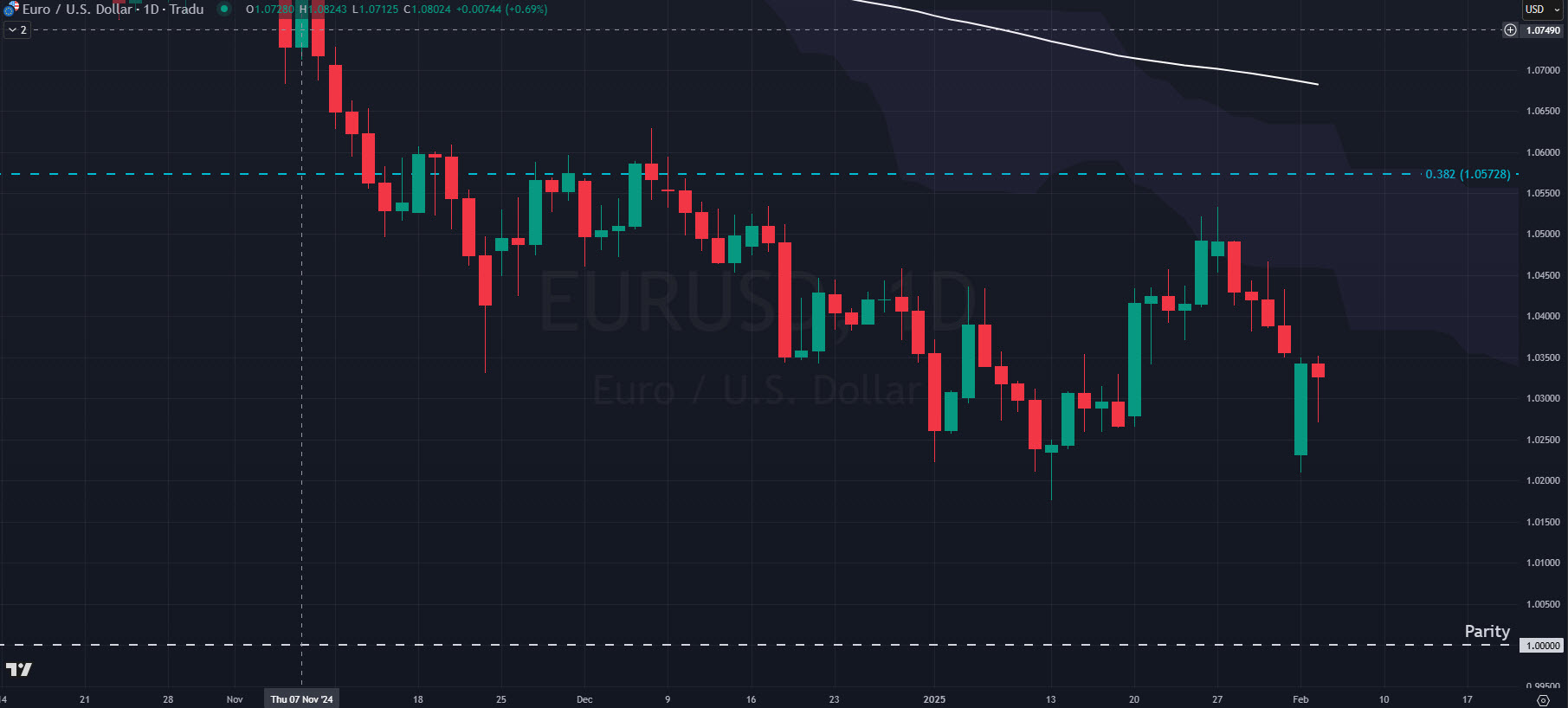
More rate cuts by the ECB, while its US counterpart slows its easing pace, is not good news for the common currency. After a 6.2% slump in 2024, EUR/USD is at risk of steeper losses and even parity, should economic weakness worsen. However, such levels may be unsustainable, as they would spike energy costs and create structural concerns around the common currency.
Tariffs begin, with uncertainty and volatility ahead
US President Trump made his opening salvo in the trade wars this week, with more tariffs and threats potentially following. Such actions would harm the economies of trading partners worldwide and could force their central banks to engage in further easing. This would, in turn, weaken their currencies against the greenback, which rises on the prospects of elevated Fed rates.
However, there is significant uncertainty surrounding the imposition of tariffs and their actual impact on global economies and currencies. Shortly after announcing levies against Mexico and Canada, he paused them while attempting to negotiate better agreements. This reveals that tariffs are a means to an end, creating the potential for varying outcomes. Lower or no tariffs could have a very different impact than what is generally expected. In any case, market volatility is likely to persist, given Trump’s bold threats and aggressive communication style.

Senior Financial Editorial Writer
Nikos Tzabouras
Nikos Tzabouras is a graduate of the Department of International & European Economic Studies at the Athens University of Economics and Business. With extensive experience in market analysis and a strong foundation in international relations, he brings a unique perspective to financial markets. Nikos emphasizes not only technical analysis but also on fundamentals and the growing influence of geopolitics on financial trends.
As a Senior Financial Editorial Writer, he delivers comprehensive and forward-looking insights across a wide range of asset classes, including equities, commodities, and currencies. His work explores how macroeconomic events, political developments, and global policies impact market dynamics, providing readers with a deeper understanding of both short-term movements and long-term trends.