
Shares
Top 10 Stocks for Q3 2025 – Part 2

Tesla, BYD, Barrick, Constellation Energy, and Nvidia are among the top stocks to watch in Q3 2025. Global equities face a challenging environment, with tariffs uncertainty and geopolitical tensions complicating the outlook. The EV market faces dangers and opportunities, demand for gold helps the mining industry, and the utilities sector is boosted by continuing AI progress.

Global equities face challenging macroeconomic environment
The return of President Trump to the White House has ushered in a period of heightened uncertainty, as a wave of sectoral and reciprocal tariffs upends established trade regimes and disrupts intricate global supply chains. While the temporary suspension of many of these levies - amid negotiations with trading partners has helped to mitigate some of the immediate impact, it has also added to the overall unpredictability.
These tariffs can dampen global growth, particularly with the world’s two largest economies - China and the United States - at the epicentre. This uncertainty has introduced volatility into global equity markets, as rising input costs and inflationary pressures weigh on corporate margins and suppress demand.
Geopolitical tensions are compounding the fragility. The conflict between Israel and Iran threatens to destabilise the strategically vital Middle East energy corridor, while the protracted war in Ukraine continues to cast a shadow over European stability. The hostilities have the potential to push oil prices higher, adding to the economic headwinds created by tariffs.
Despite these adversities, major global equity markets have managed to rebound from the Liberation Day shock, running a profitable year. Wall Street’s resurgence has been driven in large part by renewed optimism around artificial intelligence (AI). Big Tech continues to invest heavily in AI infrastructure, bolstering demand for semiconductors and helping fuel a rally in the utilities sector.
China’s economy continues to wrestle with persistent challenges - including weak domestic consumption, tariffs, and advanced technology restrictions. Nonetheless, growth in clean energy and AI remains a bright spot. The low-cost AI model developed by DeepSeek has triggered a paradigm shift, spurring accelerated investment from Chinese tech giants such as Alibaba and Baidu. Meanwhile, BYD continues to lead China’s electric vehicle (EV) revolution, remaining the top seller of electrified vehicles for three consecutive years.
In Europe, governments are working to offset the impact of tariffs and revitalise sluggish economic growth through a renewed focus on defence spending. This rearmament push, spurred by geopolitical concerns, provides a significant boost to the region’s defence sector, benefiting major contractors across the continent.
As the third quarter gets underway against a challenging and volatile backdrop, we take a look at some of the stocks that will be in our radar over the coming months. In this second instalment of a two-part series, we focus on major EV makers, mining companies, electricity providers powering the AI boom, and leading Ai chip makers. You can read part 1 here.
Tesla: High-stakes pivot to self-driving
Founded in 2003 and led by the prolific Elon Musk since 2008, Tesla has disrupted the automotive industry and remains the top global seller of pure battery electric vehicles (BEVs). Now, the company is intensifying its push into Artificial Intelligence, focusing on autonomous driving technology and humanoid robotics.
Tesla is going through a turbulent period, facing both a difficult macroeconomic environment that weighs on EV adoption, and company-specific challenges hurting its core automotive business. Rising competition, an ageing vehicle line-up, and Elon Musk’s political entanglements have all weakened the company’s appeal. President Trump’s tariffs and the rollback of electric vehicle incentives could slow EV proliferation. Tesla may prove a relative beneficiary though, thanks to its strong US manufacturing base and dominant market position.
Deliveries fell for the first time in 2024, and 2025 began on a weak note, with a 13% y/y drop in Q1 to the lowest quarterly level in nearly three years. Weaker demand and sales incentives led to a 20% y/y decline in automotive revenue, while the operating margin contracted to just 2.1% and the lowest in more than five years [1].
However, Elon Musk has now stopped his government work [2], while pledging to spend more time on his companies. He has also promised lower-cost models this quarter, which along with the refreshed Model Y could help revitalize demand. Yet, Chinese and European competitors like BYD and Renault are ahead in the race to more affordable EVs.
In any case, the CEO is laser-focused on a more ambitious vision: full self-driving and humanoid robotics. Optimus robots are already in use within Tesla factories, while the first robotaxi service was launched this month in Austin [3]. This marked and important first step, even if the rollout is of limited scale, geofenced and with personnel in the front passenger seat.
Tesla’s approach to autonomous driving differs significantly from rivals like Waymo. It eschews expensive LiDAR in favour of a camera-only, AI-powered solution. This approach is more scalable and less costly but also raising concerns over capability and safety. Additionally, Musk’s departure from DOGE and the ensuing public dispute with President Trump casts doubt over the potential introduction of policies that could support his pivot to self-driving.
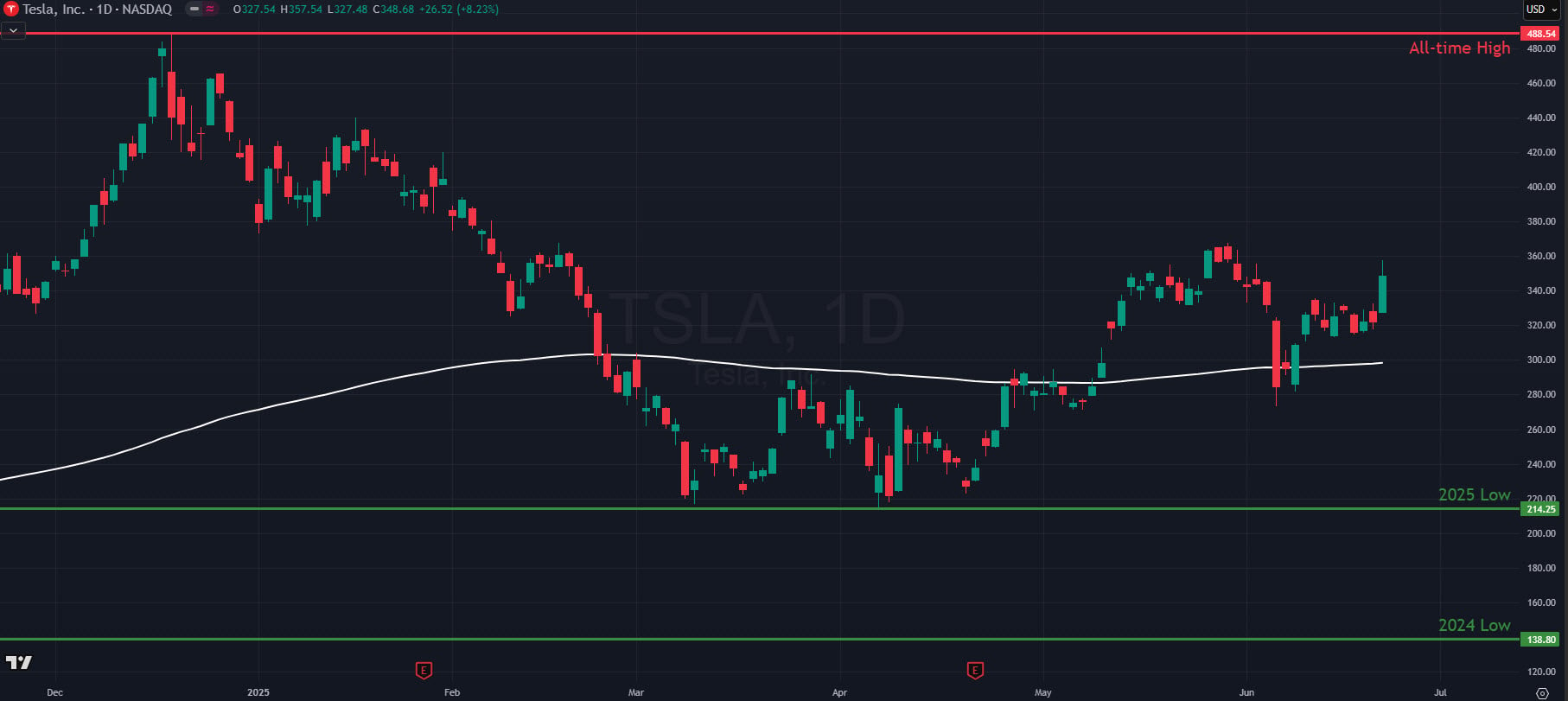
Shares of Tesla are down 13.66% year-to-date (as of the June 23 close) and mounting challenges create scope for deeper losses and new 2025 lows. On the other hand, the autonomous vision can unlock tremendous value if executed correctly and renew optimism around Tesla and its stock.
Source: www.tradingview.com
Learn more about our stocks offering.
BYD: Rise to EV leadership
Build Your Dreams (BYD) is a Chinese manufacturer of electrified vehicles, including hybrids and pure battery EVs. Founded in 1994, it quickly rose to prominence thanks to rapid technological advancements and a wide vehicle lineup. BYD has been the world’s top seller of electrified vehicles for the past three years, delivering nearly 4.3 million units in 2024 across more than 100 countries.
Although the Chinese automaker narrowly missed overtaking Tesla in pure electric car sales last year, it is well positioned to do so in 2025. As Tesla deliveries fell sharply in the first quarter, BYD recorded a 38.74% y/y increase, selling 416,388 BEVs [4]. In April, it outsold Tesla in Europe for the first time, according to JATO Dynamics [5] - marking a milestone for its global ambitions. The launch of the Dolphin Surf, priced in the 20K range [6], strengthens BYD’s ability to gain greater share in this key market, competing with affordable EV offerings from brands like Renault and Fiat.
BYD continues to push boundaries with major technological breakthroughs that support the mass adoption of electric vehicles. Its latest EV platform enables up to 400 kilometres of range from just a five-minute charge - an advancement that could significantly reduce range anxiety. In parallel, BYD is aiming to populirise autonomous driving, incorporating smart driving features across most of its vehicles [8].
Yet, pitfalls loom domestically and globally. Its European penetration can be contained by countervailing duties, while a US entry is not a viable option under the current trade regime. Furthermore, the Sino-US tariffs antagonism creates headwinds for the Chinese economy, potentially curbing demand for its products. Additionally, the domestic market is highly competitive and promotional, squeezing profitability.
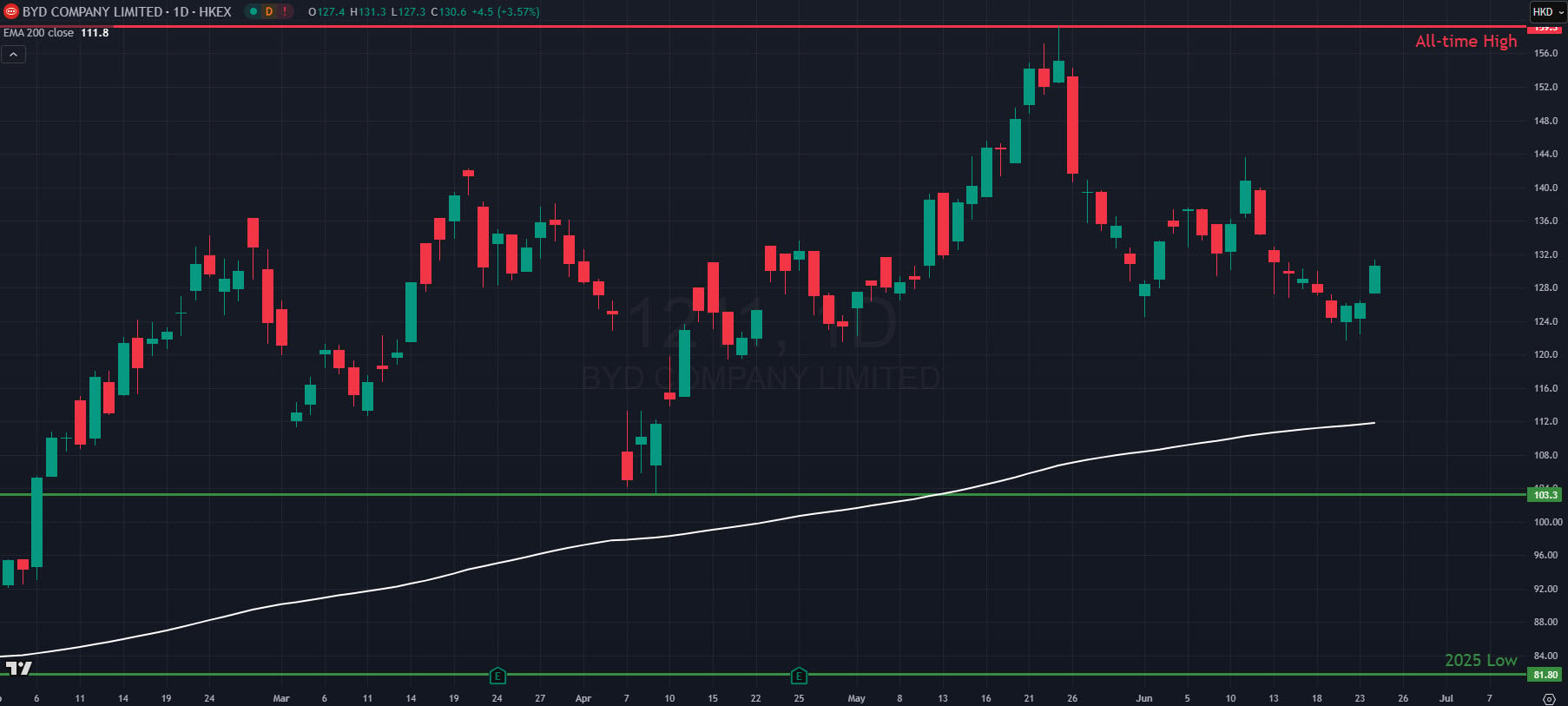
Shares of BYD (1211) rally 47% year-to-date (as the June 24 close), reaching new all-time highs. Its technological leaps and widening appeal can lead to new records. Nevertheless, a challenging operating environment in both China and global markets presents risks of a deeper correction ahead.
Source: www.tradingview.com
Barrick Mining: Beneficiary of gold and copper demand
The Canadian company is among the biggest gold producers in the world, with output of nearly four million ounces last year. While historically known for gold, it is increasingly focused on copper, producing 195,000 tonnes last year. This strategic pivot is underscored by its recent name change from Barrick Gold and its aim to increase copper output by 30% by the end of the decade [9].
Trade uncertainty, macroeconomic headwinds, geopolitical unrest, and US Dollar decline continue to spur demand for bullion. Central bank buying is another source of strength amid a de-dollarization push. The People’s Bank of China (PBoC) increased its reserves for a seventh straight month in May [10], while a World Gold Council survey showed that 43% of institutions plan to increase their reserves over the next twelve months. [11]
Meanwhile, copper is benefitting from the Artificial Intelligence boom and the clean energy transition. Big Tech is pouring capital into next-generation infrastructure, with PwC projecting $1 trillion in data centre investment by 2027 [12]. This surge in energy demand supports renewable generation, while a potential rebound in electric vehicle (EV) adoption adds further tailwinds for copper. These forces have driven both gold and copper prices to all-time highs in 2025.
Against this favourable backdrop, Barrick delivered a strong first quarter. Revenues rose 14% y/y, while net earnings surged by 61%. Debt also declined on a sequential basis, reinforcing the company’s solid financial footing. [13]
That said, headwinds persist. Tariff-related economic concerns and the Trump administration’s rollback of clean energy policies could temper copper demand. Meanwhile, gold prices - after a powerful rally - have begun to show signs of fatigue. In addition, a dispute with the Malian government raises risks around a key asset in Barrick’s portfolio. [14]
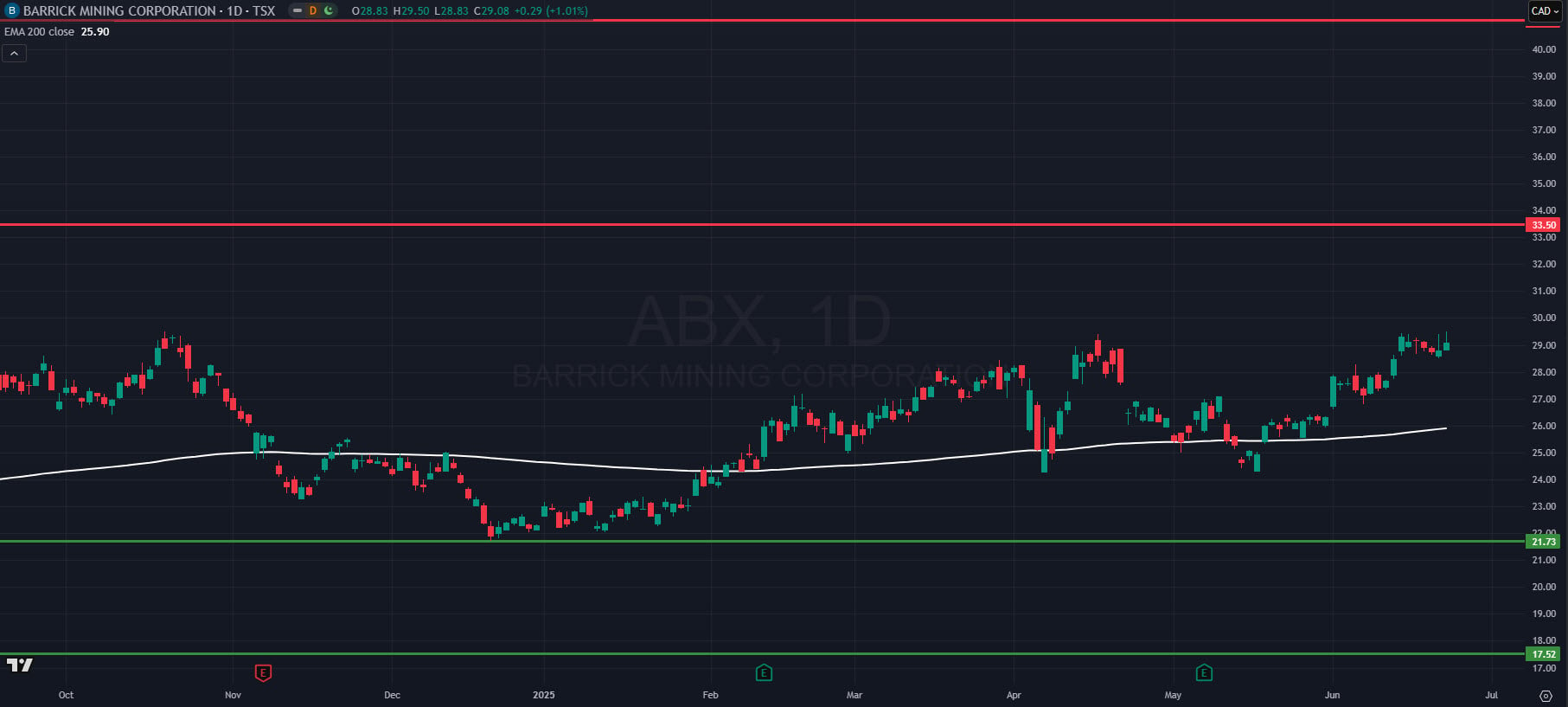
Shares of Barrick (ABX) rise 30.5% in year-to-date (as of the June 23 close), buoyed by strong financials and robust metals demand. This can continue amid geopolitical uncertainty and AI proliferation, creating scope for further gains. Nonetheless, trade uncertainty and difficult macroeconomic backdrop can pose headwinds and push the stock lower.
Source: www.tradingview.com
Constellation Energy: At the forefront of powering the AI boom
Constellation is a key electricity provider in the US with capacity of 32,400 MW, serving 16 million homes and businesses across most of the United States. It is the largest producer of carbon-free energy in the United States, with the vast majority of its generation coming from nuclear power. [15]
The utilities sector is a key beneficiary of the Artificial Intelligence (AI) boom, ranking among the top-performing industries in the S&P 500 this year. According to the International Energy Agency (IEA), data centres in the US are expected to account for “almost half of the growth in electricity demand” between now and 2030 [16]. In its June Short-Term Energy Outlook, the US Energy Information Administration (EIA) forecasts that nuclear will contribute 19% of this year’s total electricity generation, with overall consumption continuing to rise. [17]
Nuclear energy plays an increasingly important role, being preferred by Big Tech to power their AI needs. Constellation is at the forefront of this shift, having struck an agreement with Microsoft to restart the Three Mile Island plant [18] and a separate deal to supply Meta with nuclear-generated electricity [19]. Moreover, with President Trump rolling back renewable energy initiatives and signing executive orders to promote nuclear development [20], Constellation stands to benefit - something the company has openly welcomed. [21]
Still, risks remain. Global trade tensions and concerns about a potential US economic slowdown could dampen investment and impede progress in AI infrastructure. In addition, the reversal of the Biden-era Green New Deal could restrict the expansion of electric vehicles, one of the key sources of future electricity demand.
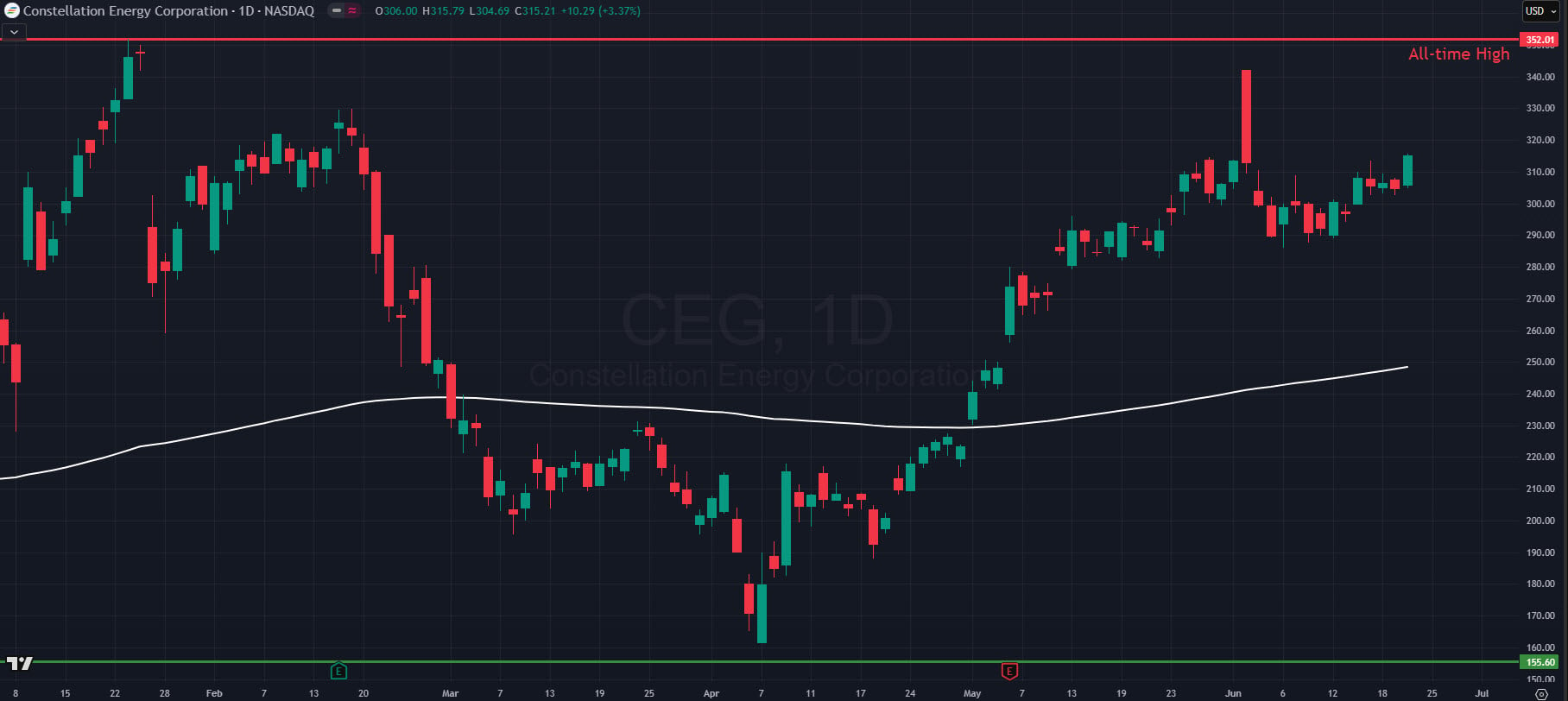
Shares of Constellation Energy (CEG) rally 40.9% year-to-date (as of the June 23 close). The combination of surging AI-related energy needs and favourable nuclear policy positions the stock for continued outperformance and fresh all-time highs. However, this has been a volatile year amid challenges to US AI leadership and fears of economic slowdown from tariffs, making CEG vulnerable to renewed pressures.
Source: www.tradingview.com
Nvidia: The AI standard-bearer
Nvidia is a leading designer of semiconductors, systems, and software that has enabled the Artificial Intelligence boom through its accelerated computing. Its infrastructure is the industry standard for training and inference of large language models (LLMs), commanding 92% of the data centre GPU market, according to IoT Analytics. [22]
Its latest earnings underscored this dominant position, with sales surging on “incredibly strong” demand for its AI infrastructure. Revenues soared 69% y/y to a record $44.06 billion in Q1 FY26 (quarter ended 7 April), despite leaving $8 billion on the table due to export restrictions to China [23]. Nvidia is increasing its release cadence, unveiling new AI architecture annually to meet insatiable demand. The recent DeepSeek breakthrough has further intensified the AI race, prompting US tech giants such as Meta Platforms and Google to accelerate their investments.
Yet, revenue growth is slowing - a trend that the company expects to continue in the current quarter. Management forecasts a 49.8% increase, which would mark the slowest pace in over two years. That could worry markets against a still challenging macroeconomic environment.
Nvidia is exposed to tariffs given that its supply chains are mainly concentrated in the Asia-Pacific region. Although the Trump administration has scrapped the AI Diffusion Rule [24], curbs on exports to China are likely to remain, potentially cutting off a key source of future growth. While Nvidia’s dominance in AI remains largely uncontested, it is not going to last forever. AMD has struggled to catch up, but the appearance of OpenAI CEO Sam Altman in the unveiling of its next gen AI chip, shows that it may be on the right track. [25]
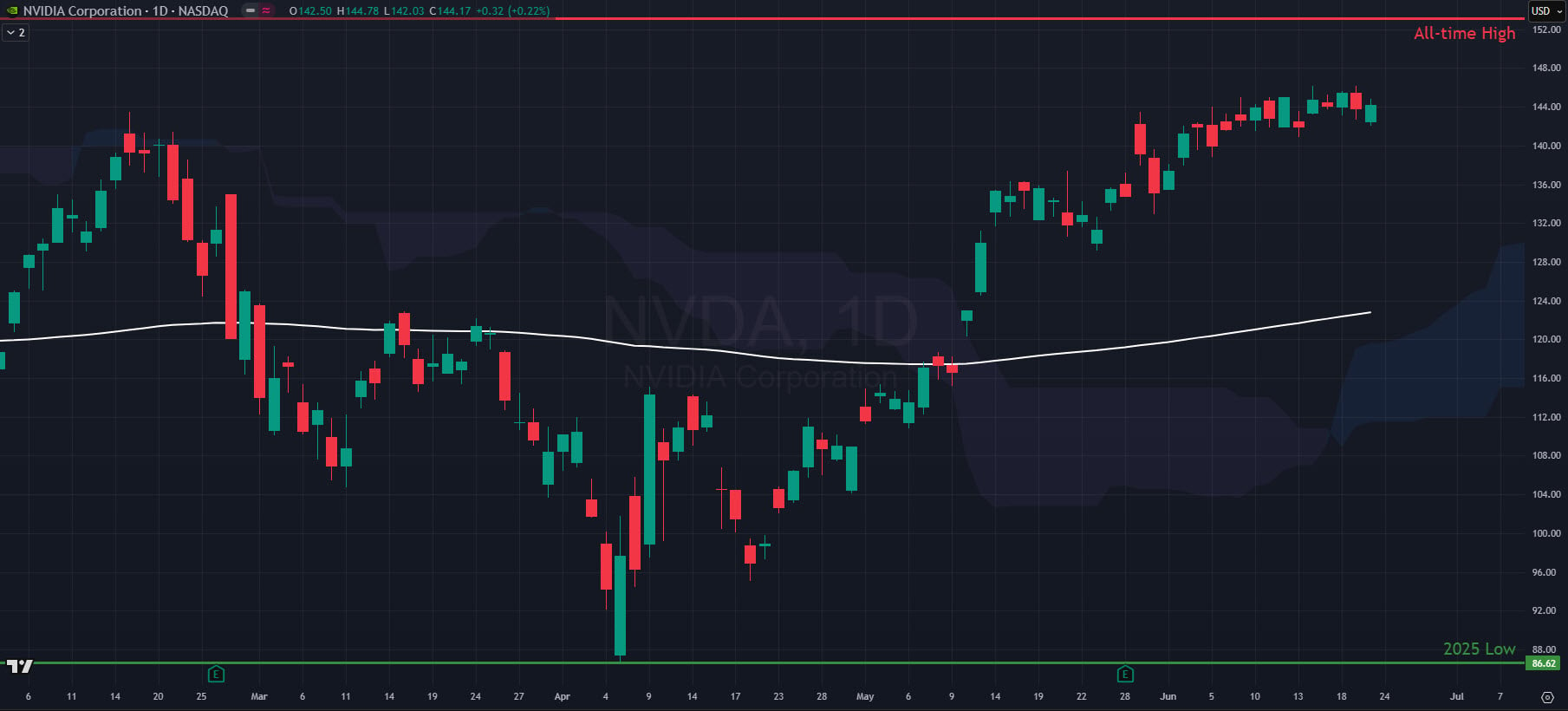
After a weak start to the year, Nvidia shares have moved into positive territory, gaining 7.4% year-to-date (as of the 23 June close). Thanks to strong Big Tech investment and its commanding market position, Nvidia is well-placed to benefit further and reach new record highs. Still, tariffs and export curbs pose real risks, leaving NVDA susceptible to renewed volatility and pullbacks.
Source: www.tradingview.com
Senior Financial Editorial Writer
Nikos Tzabouras
Nikos Tzabouras is a graduate of the Department of International & European Economic Studies at the Athens University of Economics and Business. With extensive experience in market analysis and a strong foundation in international relations, he brings a unique perspective to financial markets. Nikos emphasizes not only technical analysis but also on fundamentals and the growing influence of geopolitics on financial trends.
As a Senior Financial Editorial Writer, he delivers comprehensive and forward-looking insights across a wide range of asset classes, including equities, commodities, and currencies. His work explores how macroeconomic events, political developments, and global policies impact market dynamics, providing readers with a deeper understanding of both short-term movements and long-term trends.