
Commodities
Israel strikes Iran: What’s next for oil prices?

Israel launched airstrikes against Iranian nuclear facilities, sending crude oil prices sharply higher. The Israel–Iran conflict has triggered fears of broader escalation and potential oil supply disruptions, increasing the geopolitical risk premium. However, the US denial of involvement creates hopes of a more limited conflict, which could contain the rally in oil prices.
USOil Analysis
Israel launched operation “Rising Lion” on Friday, targeting Iranian nuclear facilities. Prime Minister Netanyahu said the operation will continue for “as many days as it takes to remove this threat” [1]. The military action came after the International Atomic Energy Agency (IAEA) found Iran in breach of its obligations. [2]
Earlier this week, US President Trump expressed “much less” confidence in reaching a nuclear deal with Tehran [3]. He had also confirmed a reduction in US personnel in the Middle East, describing the region as “potentially dangerous” and prompting speculation over possible military escalation. [4]
Iran has vowed to retaliate [5] and has reportedly already launched drone attacks against Israel [6]. These developments have heightened fears of a broader conflict, pushing investors towards safe-haven assets like gold. Geopolitical tensions and concerns over potential disruptions to oil supply have driven oil prices higher, as markets reconsider the previously negative supply-demand outlook. The situation may unfold over several days, sustaining volatility and supporting further gains.
Source: www.tradingview.com
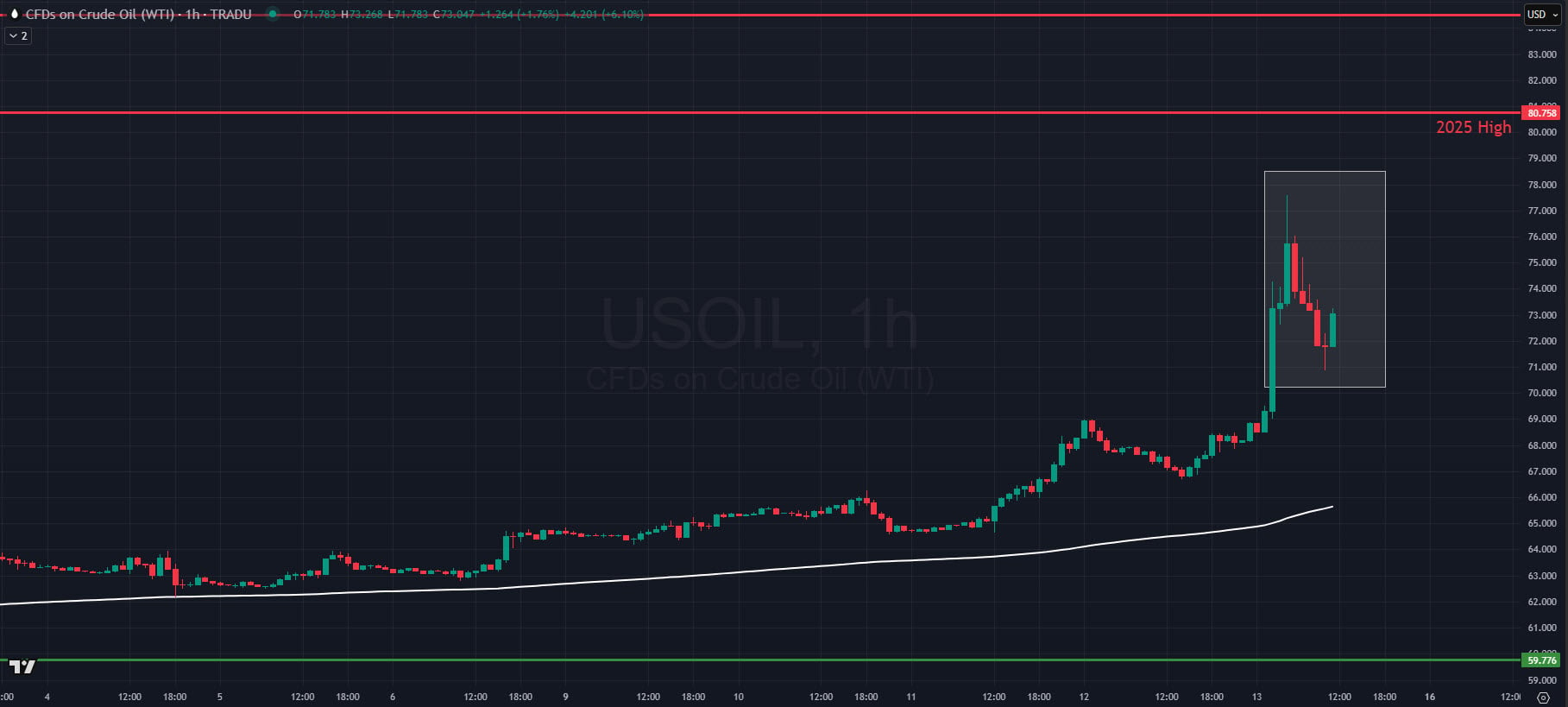
The surge places USOil in a position to challenge the 2025 peak (80.758), although sustained strength would require actual supply interruptions. These could stem from damage to Iran’s oil infrastructure or a blockade of the Strait of Hormuz. Iran remains one of OPEC’s top producers, consistently pumping over 3 million barrels per day this year, according to the International Energy Agency (IEA) [7]. Meanwhile, The Strait of Hormuz is a critical transit chokepoint, accounting for nearly a quarter of global oil flows in 2023, according to the US Energy Information Administration (EIA). [8]
At present, there are no confirmed reports of damage to Iranian refineries. Moreover, closing the Strait of Hormuz would be a highly risky move by Tehran. US Secretary of State Rubio characterised the Israeli strike as a “unilateral action”, denying any American involvement [9]. This denial could offer Tehran a diplomatic offramp, allowing for a restrained response and the continuation of nuclear negotiations.
A more limited conflict could pressure USOil and we are already seeing a pullback from the original surge. Furthermore, elevated oil prices may cause domestic headaches for the White House. Such outcome would hinder Trump’s push to tame inflation and his preference for lower interest rates.
Learn more about how to trade commodities.
Senior Financial Editorial Writer
Nikos Tzabouras
Nikos Tzabouras is a graduate of the Department of International & European Economic Studies at the Athens University of Economics and Business. With extensive experience in market analysis and a strong foundation in international relations, he brings a unique perspective to financial markets. Nikos emphasizes not only technical analysis but also on fundamentals and the growing influence of geopolitics on financial trends.
As a Senior Financial Editorial Writer, he delivers comprehensive and forward-looking insights across a wide range of asset classes, including equities, commodities, and currencies. His work explores how macroeconomic events, political developments, and global policies impact market dynamics, providing readers with a deeper understanding of both short-term movements and long-term trends.