
Forex
EU-US tariff deal: What’s next for EUR/USD?

The EU–US trade agreement, which sets lower tariffs of 15% on most EU exports - including cars - could benefit the European economy and support the ECB’s decision to hold rates. This environment may sustain the euro’s strength and allow EUR/USD to set new highs. However, tariffs remain elevated, while ongoing trade uncertainties and macroeconomic headwinds create room for corrections in the currency pair.

EU-US trade deal can support euro strength, but downward risks remain
The European Union and the United States announced a trade agreement on Sunday that sets a 15% tariff on most European goods entering the US, avoiding the higher 30% rate President Trump had threatened to implement from 1 August. Crucially, EU Commission President Ursula von der Leyen confirmed that the 15% rate includes cars [1]. Automakers are currently subject to much higher sectoral duties, which have already taken their toll. Highlighting these headwinds, Volkswagen slashed its full-year guidance, now expecting operating profits of 4–5% (down from the previously forecast 5.5–5.6%) and flat revenues (revised from an earlier projection of 5% growth). [2]
The United States is the EU’s largest trading partner, accounting for 20.6% of its exports in 2024, worth well over €500 billion [3]. Therefore, the agreement can provide stability, support key industries, and allow the fragile European economy to extend its recovery. This effort is driven by Europe’s rearmament push and infrastructure spending, with the ECB President noting that such investments can support growth over time. [4]
The news follows a hawkish hold by the European Central Bank last week, with President Lagarde stating that officials are now “in a good place to hold and to watch”. After 200 basis points of rate cuts and inflation within target, policymakers can afford to remain cautious about further easing. The trade agreement with the US supports this approach, potentially reducing the need for additional stimulus or sub-neutral rates.
On the other hand, these tariff rates are still much higher than those in place before Trump’s return to the White House, so economic headwinds may linger. Additionally, a lack of detail creates uncertainty around interpretation and implementation. For example, Ms von der Leyen said the deal covers pharmaceuticals – the EU’s top export to the US – but appeared to acknowledge that the rate could change, as President Trump considers separate sectoral tariffs.
EUR/USD has the opportunity to extend this year’s rally and set new 2025 highs following the agreement, which could improve the economic outlook and potentially keep the ECB on the sidelines. Meanwhile, dollar weaknesses may persist amid concerns over Fed independence and rising debt.
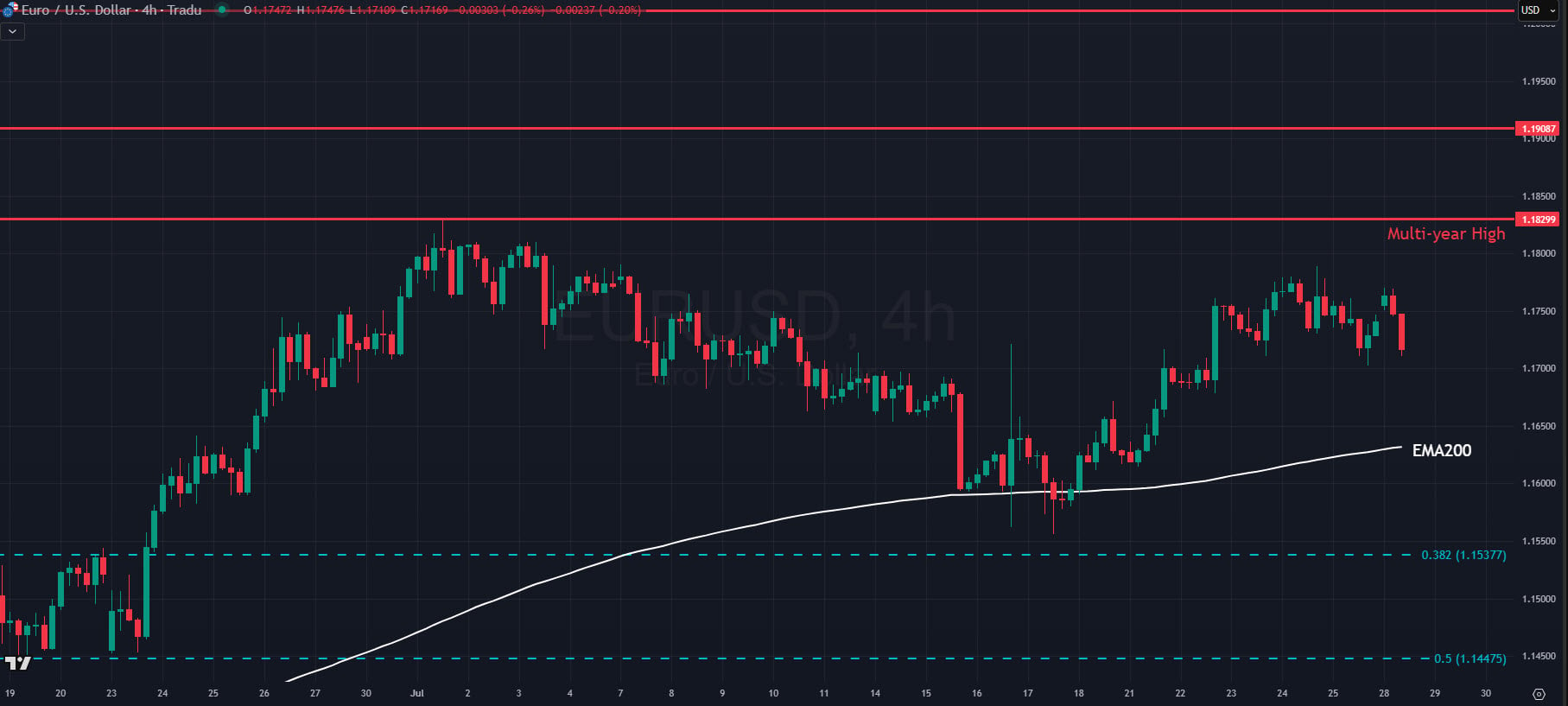
Source: www.tradingview.com
Nonetheless, trade uncertainties and economic headwinds are unlikely to disappear completely, meaning the ECB might still need to deliver more easing this year. Furthermore, a stronger euro could pose challenges by impeding growth and exports. ECB Vice President Luis de Guindos recently alluded to exchange rate considerations, telling Bloomberg that anything above 1.2000 would be “much more complicated” [5]. With the pair not far from this level, further gains may prove difficult.
While the trade deal could benefit European growth, it may also ease concerns about the US economy. This, in turn, could reinforce the Fed’s cautious stance on rate cuts. Such an outcome might support a rebound in the greenback and weigh on EUR/USD. Despite opening higher on Monday, the pair erased initial gains, reflecting broader macroeconomic and monetary complexities. The EMA200 and the 38.2% Fibonacci retracement level can fend off pullbacks and reaffirm the bullish bias, but a breach could open the door to deeper corrections.
Senior Financial Editorial Writer
Nikos Tzabouras
Nikos Tzabouras is a graduate of the Department of International & European Economic Studies at the Athens University of Economics and Business. With extensive experience in market analysis and a strong foundation in international relations, he brings a unique perspective to financial markets. Nikos emphasizes not only technical analysis but also on fundamentals and the growing influence of geopolitics on financial trends.
As a Senior Financial Editorial Writer, he delivers comprehensive and forward-looking insights across a wide range of asset classes, including equities, commodities, and currencies. His work explores how macroeconomic events, political developments, and global policies impact market dynamics, providing readers with a deeper understanding of both short-term movements and long-term trends.