
Forex
EUR/USD maintains bullish bias ahead of pivotal ECB rate decision

The latest Trump tariff threat complicates the rate path of the European Central Bank (ECB) and Thursday’s decision could determine the trajectory of EUR/USD. With the ECB nearing the end of its easing cycle and markets widely expecting a pause after seven consecutive cuts, the Euro could extend its rally from earlier this year. The technical picture also remains supportive, as EUR/USD has held above key support levels. However, the proposed Trump tariffs risk damaging the already fragile European economy, potentially forcing the ECB to lower rates. Any dovish signals amid trade uncertainty could weigh on the Euro.

Euro rally faces ECB test
After reaching a near four-year high at the start of July, EUR/USD experienced a pullback but managed to hold above both the 200-day EMA and the 38.2% Fibonacci retracement of its recent upward leg. The rebound from this critical support cluster reaffirms the bullish bias that continues to guide the common currency towards fresh highs. However, the pair has lost ground this month as the US dollar rebounds, making it vulnerable to renewed pressures. A drop below the aforementioned support area could open the door to deeper corrections. The Euro’s momentum will be tested by the ECB’s pivotal rate decision on Thursday.
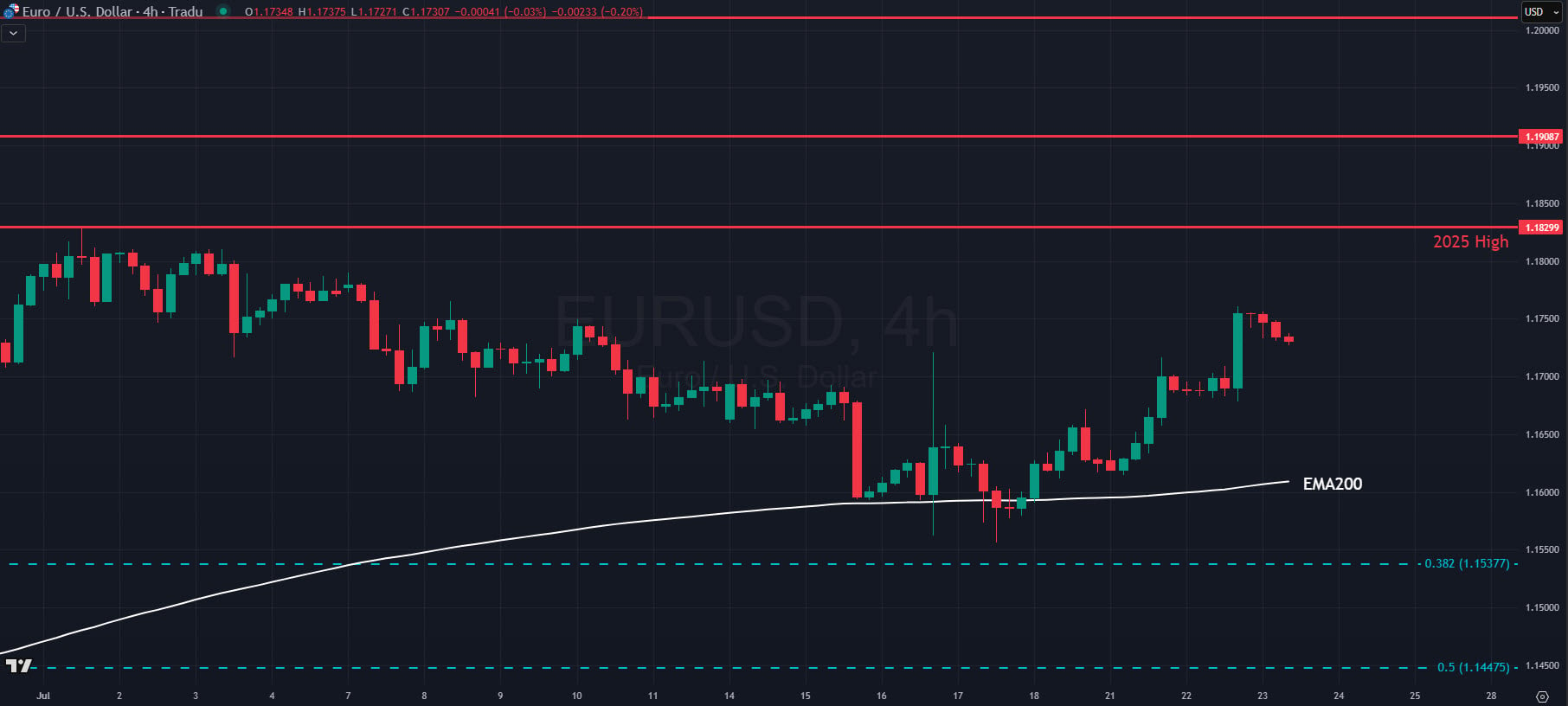
Source: www.tradingview.com
The European Central Bank has already implemented 200 basis points of easing since its June 2024 pivot, bringing rates into the neutral range and the lowest in nearly three years. At the same time, inflation has returned to target, the European economy is showing signs of recovery, and the historic rearmament drive could support further growth. This backdrop limits the willingness for additional rate cuts and brings the ECB close to the end of its easing cycle. Policymakers have hinted at a pause [1], and markets broadly expect such an outcome on Thursday. This would mark a significant shift following seven consecutive cuts and could provide room for the Euro to extend its advance.
However, Donald Trump’s planned 30% tariffs threaten the EUR/USD rally as they complicate the ECB’s rate trajectory [2]. These duties on EU imports, effective from 1 August, may intensify the drag from existing tariffs and undermine the fragile recovery prospects of the European economy. The 30% rate is higher than the ECB’s tested scenarios in its last economic projections [3] and could force policymakers to additional cuts and sub-neutral rates to shield the economy. Even if rates remain unchanged on Thursday as expected, any dovish tone could weigh on the Euro.
On the other hand, ECB officials may choose to look through this threat, as the European Union and United States remain engaged in trade negotiations that could alter the final tariff terms. Tuesday’s US-Japan agreement, which saw tariffs reduced to 15% from the previously threatened 25% [4], offers hope for a similarly constructive resolution.
The trajectory of EUR/USD will also depend on the performance of the greenback. Following a significant decline in the first half of the year, the US dollar has rebounded this month, regaining some lost confidence and safe-haven appeal. Nevertheless, the dollar may come under renewed pressure amid ongoing trade and fiscal uncertainty, rising concerns over the Federal Reserve’s independence, and expectations that the Fed will begin cutting rates in the second half of the year.
Senior Financial Editorial Writer
Nikos Tzabouras
Nikos Tzabouras is a graduate of the Department of International & European Economic Studies at the Athens University of Economics and Business. With extensive experience in market analysis and a strong foundation in international relations, he brings a unique perspective to financial markets. Nikos emphasizes not only technical analysis but also on fundamentals and the growing influence of geopolitics on financial trends.
As a Senior Financial Editorial Writer, he delivers comprehensive and forward-looking insights across a wide range of asset classes, including equities, commodities, and currencies. His work explores how macroeconomic events, political developments, and global policies impact market dynamics, providing readers with a deeper understanding of both short-term movements and long-term trends.