
Indices
US Court Strikes Down Trump-Era Tariffs, Clouding Fiscal Outlook

A US court ruling striking down Trump-era tariffs has upended a key economic policy, casting doubt on trade talks and tax reform plans. With the administration appealing, legal uncertainty lingers. Markets rallied on the news, but lasting momentum may depend on a definitive resolution in the weeks ahead.

Introduction
Yesterday, the Manhattan-based US Court of International Trade struck down the tariffs imposed by the Trump administration. The ruling was that President Trump exceeded the authority granted under the 1977 International Emergency Economic Powers Act (IEEPA).
The decision, made by a three-judge panel, delivers a significant blow to the Trump administration’s economic strategy.
Moreover, it has far-reaching ramifications for the trade negotiations currently taking place between the Trump administration and other countries. Exporters to the US will be watching the case closely and will be wondering whether the 9 July deadline still carries any weight.
Furthermore, it will complicate the administration’s planned tax reforms and proposed extension of tax cuts, given that revenue from tariffs now comes into question.
Question Regarding Tax Reform
The court’s decision may complicate the Trump administration’s tax reform package, which is currently under review in the Senate. The plan seeks to extend and modestly expand the 2017 tax cuts. The administration had argued that revenue from the imposed tariffs would help offset the resulting increase in the deficit, potentially generating between $2.3 trillion and $3.3 trillion over a decade.
However, the ruling casts doubt on that assumption, raising fresh concerns over fiscal stability. These concerns have already contributed to a rise in the 10-year US Treasury yield, now above 4.5%, which could push up borrowing costs for households and businesses.
The Court Ruling
In its judgment, the panel of judges questioned whether the IEEPA in fact granted President Trump the authority to impose the unlimited tariffs announced on 2 April and concluded that the Act did not provide such authorisation. Accordingly, the court set aside the tariffs.
Importantly, the ruling affects tariffs on China, Canada, and Mexico that were imposed over their alleged failure to curb fentanyl shipments into the US. However, tariffs on aluminium, steel, and autos — implemented under national security laws — remain in place.
The judgment gives the administration 10 days to implement the order. After that, customs officials must stop collecting the tariffs.
Unsurprisingly, the administration has filed a notice to appeal the judgement.
Market Reaction
Markets initially rallied on the news, with S&P 500 futures rising 1.5%.
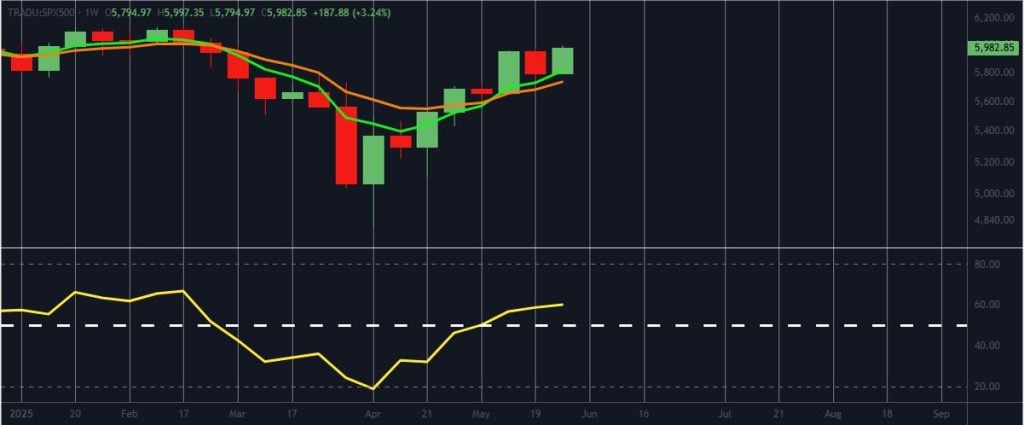
Source: www.tradingview.com
The S&P 500 is now up nearly 20% from its 7 April low. Technically, longer-term bullish signals are emerging. The EMAs on the weekly chart are in a bullish formation, showing upward angle and separation, while the RSI remains comfortably above 50. As long as these conditions hold, the underlying momentum is likely to stay positive.
However, there are caveats. The US 10-year Treasury yield remains just above 4.5%. A meaningful move higher could signal persistent concerns about the deficit, which may start to weigh on equity markets.
The dollar initially strengthened but has since pulled back from its highs, while gold dipped on the news but is trading well above the day’s low at around $3,280—perhaps also reflecting ongoing deficit concerns.
However, with an appeal still pending, this story is far from over. If the legal process ultimately resolves the uncertainty surrounding tariffs, markets may be poised for further gains.
Conclusion
The court’s ruling marks a significant legal and political development, challenging the foundations of a key pillar in the Trump administration’s economic policy. Its immediate impact on tariffs—and the broader implications for fiscal planning and trade negotiations—cannot be overstated. While markets welcomed the initial clarity, the ongoing appeal means uncertainty still lingers. Should the legal process bring a definitive end to the tariff issue, it could remove a persistent overhang on investor sentiment and support further market appreciation. Until then, both policymakers and market participants will be watching closely.
Senior Market Specialist
Russell Shor
Russell Shor is a Senior Market Strategist at Tradu, having been promoted to the role in 2025 in recognition of his depth of insight and consistent delivery of high-impact market analysis. He originally joined FXCM in October 2017 as a Senior Market Specialist.
Russell holds an Honours Degree in Economics from the University of South Africa, is a certified FMVA®, and a full member of the Society of Technical Analysts (UK). With over 20 years of experience in financial markets, his work is renowned for its clarity, precision, and strategic value across asset classes.