
Shares
AI demand drives Nvidia to record Q1 FY26 revenue, but China and tariff risks loom

Nvidia posted solid Q1 FY26 earnings on strong demand for its AI chips and Big Tech spending on data centres, which can allow the stock to extend the recovery. However, the pace of revenue growth slowed further and Nvidia expects this trend to persist in the current quarter as it takes a hit from export restrictions on advanced semiconductors to China.

Continued AI chip demand boosts Nvidia’s revenue
The success of DeepSeek’s low-cost large language model questioned US tech dominance and the need for massive investments in the most powerful infrastructure. However, lower training costs support the proliferation and adoption of AI models, driving increased demand for inference.
Speaking on Bloomberg following Wednesday’s results, Nvidia CEO Jensen Huang stated that demand for reasoning AI inference is “off the charts.” He attributed this surge to the popularity of AI services such as ChatGPT, Gemini, Grok, and others.
In response to rising competition from China, US Big Tech has doubled down on AI development, committing to significantly higher spending in 2025. Nvidia is a major beneficiary of this trend, as its infrastructure remains the go-to solution for AI development and deployment.
- Meta Platforms boosted its 2025 capital expenditure guidance to $64–72 billion, marking an at least 63% year-on-year increase.
- Alphabet reiterated its commitment to spend $75 billion - a 47% jump.
- Microsoft expects further growth in the fiscal year beginning July, from the current $80 billion, even if at a more moderate pace.
Its latest architecture, Blackwell, is now in full production and “built to power the full AI life cycle”, according to the CEO’s earnings call remarks. CFO Colette Kress added that Blackwell contributed nearly 70% of data centre compute revenue in the reported quarter.
Nvidia reported record revenues of $44.06 billion in Q1 FY26 (quarter ended 7 April), driven by “incredibly strong” demand for its AI infrastructure. This marks a 69% year-on-year increase, surpassing company forecasts.
Learn more about our stocks offering.
China export restrictions and tariffs threaten Nvidia’s growth
Despite these strong results, Nvidia’s growth rate is decelerating, and the company expects this trend to continue. Although still robust, the projected 49.8% year-on-year revenue growth for the current quarter would be the slowest in over two years.

This slowdown is largely attributed to US export restrictions on advanced technology to China, which Nvidia estimates will cost $8 billion in lost revenue this quarter. The company is currently unable to ship the previously approved H20 chips, and the CEO admitted that there are no solutions under the current stringent rules. Mr Huang did not mince words as he criticized the policy, saying that with a $50 billion market effectively closed for the US industry, China develops its own AI chips.
Although the Trump administration rescinded the Biden-era AI Diffusion Rule - raising hopes for a less restrictive regulatory regime major relaxations on exports to China remain unlikely. Furthermore, Nvidia is not immune to the broader macroeconomic challenges. Tariffs imposed by the Trump administration have created uncertainty, threatening both US and global economies, which could deter investment and slow data centre expansion. This could ultimately hurt demand for Nvidia’s products.
Still, the 90-day drop in reciprocal tariffs, the exemption of semiconductors from the China levies, and prospects of new trade agreements with partners could help ease these headwinds. Additionally, the US President’s Middle East trip yielded results for Nvidia, which can help mitigate some of the China losses. Saudi Arabia agreed to buy 18,000 AI chips- the first in what is expected to be several hundred thousand . The United Arab Emirates could also 500,000 advanced chips per year, according to Reuters.
Nvidia shares recover but headwinds could persist
The proliferation of AI and the emergence of new iterations such as AI agents continue to fuel inference demand, with tech giants ramping up investment in AI infrastructure. Nvidia remains the industry leader, and Wednesday’s results demonstrated both strong demand and a degree of resilience against export restrictions.
Following the Liberation Day shock, Nvidia’s shares have recouped this year’s earlier losses, aided by the temporary pause in tariffs and optimism over potential easing of export curbs. Wednesday’s results allow NVDA to push higher and set new all-time highs.
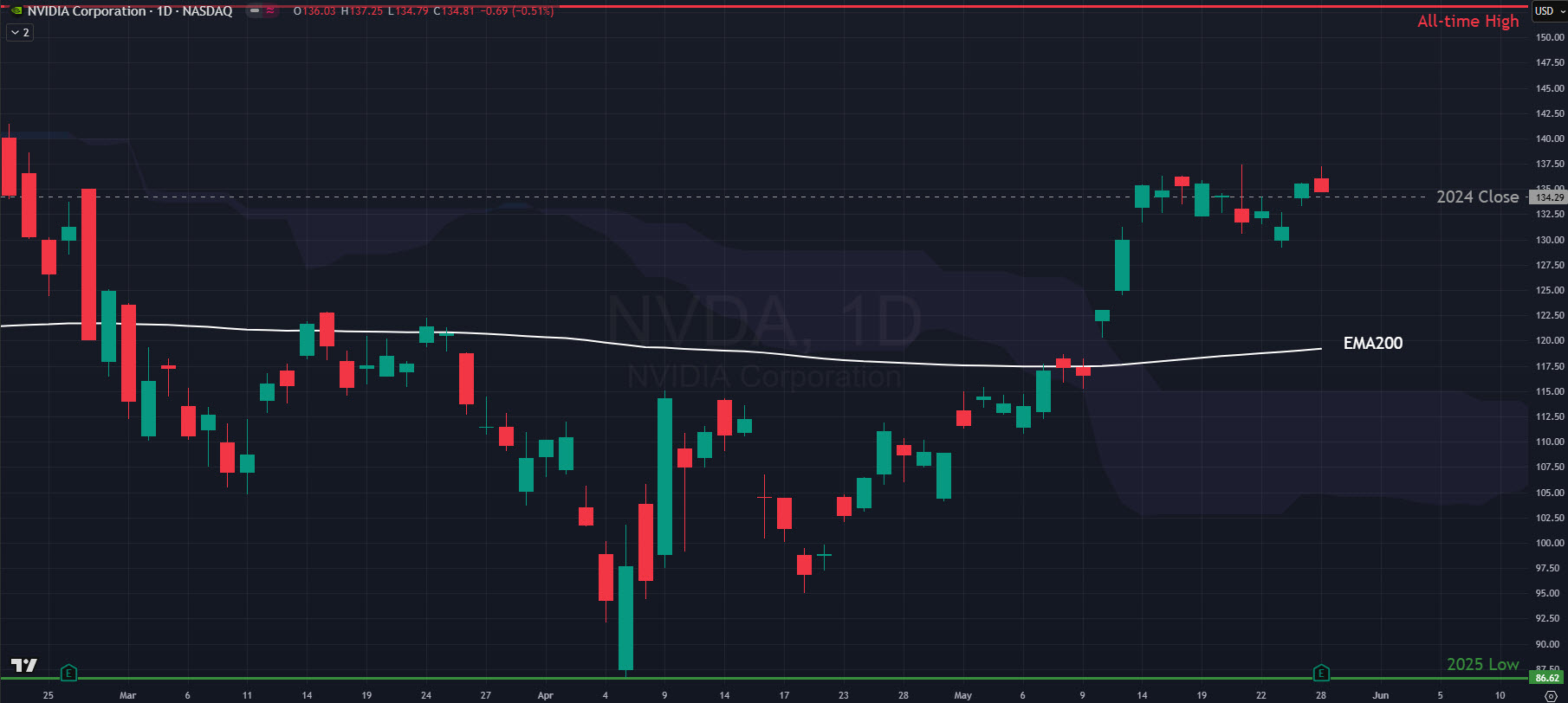
Source: www.tradingview.com
However, persistent export restrictions to China weigh revenue growth. The deceleration can worry investors against a still challenging macroeconomic backdrop, as trade uncertainty persists. These factors may renew downward pressure on the stock, leaving it vulnerable to dips below its 200-day moving average, which would negate the bullish momentum.
Senior Financial Editorial Writer
Nikos Tzabouras
Nikos Tzabouras is a graduate of the Department of International & European Economic Studies at the Athens University of Economics and Business. With extensive experience in market analysis and a strong foundation in international relations, he brings a unique perspective to financial markets. Nikos emphasizes not only technical analysis but also on fundamentals and the growing influence of geopolitics on financial trends.
As a Senior Financial Editorial Writer, he delivers comprehensive and forward-looking insights across a wide range of asset classes, including equities, commodities, and currencies. His work explores how macroeconomic events, political developments, and global policies impact market dynamics, providing readers with a deeper understanding of both short-term movements and long-term trends.