
Shares
Market Peaks and Potential Resistance: Indicators Every Trader Should Monitor

SPX, Dow Jones and Nasdaq analysis
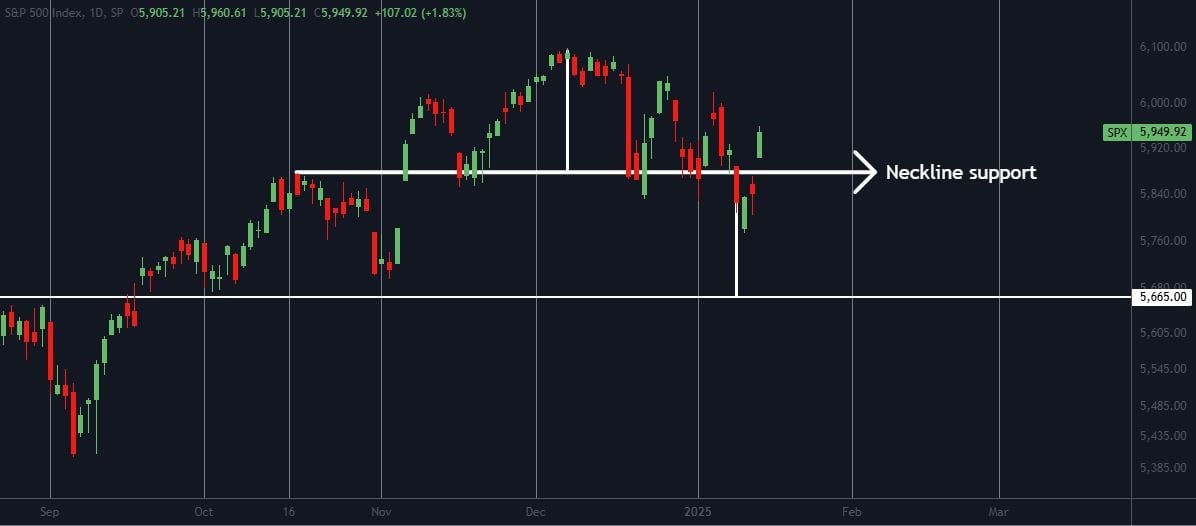
We want to keep an eye on the stock market, as the indexes appear top-heavy on their respective daily charts. Take the SPX, for example:
Source: www.tradingview.com
We note that there is neckline support around the 5,880 level. This was briefly breached to the downside on 10 January but has since gapped up impressively, with bulls holding firm at support. This move was largely driven by yields declining significantly after core CPI came in lower than expected at 3.2% (versus 3.3%). Nevertheless, the neckline support should continue to be monitored. A breakdown below this level would suggest a tentative target around 5,665, representing a 4.78% decline and bringing the price to the July-August highs, which could offer a logical support level.
If prices were to decline to 5,665, it could be due to a contraction in the P/E multiple and/or in aggregate EPS for the S&P 500. Assuming a price multiple of 21x, the EPS would decrease from 285 to approximately 269, making Q4 earnings and forward guidance particularly important to assess. It’s not just the S&P 500 that appears to be facing resistance at elevated levels. The Dow Jones Industrial Average also exhibits a neckline support level, which it has tested but remains trading above for now. Similarly, the Nasdaq’s critical threshold is at 20,600; a breach of this level could signal potential weakness in the tech-heavy index as 2025 progresses.
Loss of Market Momentum: What traders need to know
Source: www.tradingview.com
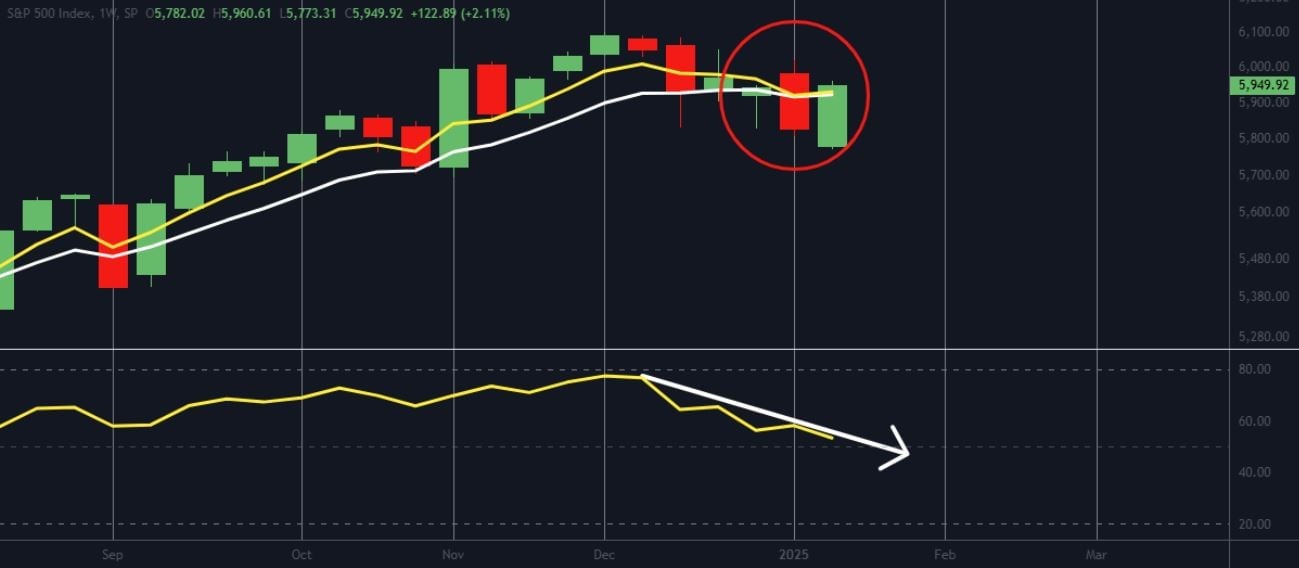
Since the Federal Reserve’s meeting on 18 December, where the central bank cut rates by 25 basis points but cautioned against further rate reductions, suggesting it would likely only cut twice in 2025 (according to the dot plot), there has been a marked decline in the S&P 500’s market momentum. This is evident from the downward-sloping RSI (white trendline). The SPX’s EMAs have yet to register a bearish cross. However, this is the likely outcome if the RSI dips and remains below 50, as persistent downward momentum is exerted.
In effect, the interest rate fundamentals have shifted since that meeting. The market is readjusting to the possibility of fewer rate cuts than previously anticipated. This is reflected in the sharp appreciation of the US 10-year yield since then, rising to around 4.65%. A yield above 4.5% is likely to weigh on the stock market. Therefore, we will need to see some relief in order to reassert the tailwinds that yields provided in 2024.
However, that may be a tough ask given Trump tariffs. The reimplementation of tariffs under former President Donald Trump's administration has raised concerns about potential inflationary effects on the U.S. economy. Economists argue that tariffs on imports, particularly from China and other major trading partners, could lead to higher costs for businesses and consumers. These increased costs may result in higher prices for a wide range of goods, from consumer electronics to raw materials, thereby contributing to inflation. Additionally, the uncertainty surrounding trade policies could disrupt supply chains and further drive up prices. While some argue that tariffs could protect domestic industries, the overall consensus is that the inflationary pressures they create could outweigh any potential benefits.
Some Movement on Tariff News
There has been some positive news on tariffs: President-elect Donald Trump's economic team is reportedly considering a gradual increase in tariffs of 2% to 5% per month. This measured approach contrasts with an immediate hike and aims to strengthen negotiation leverage while minimising inflation risks. The plan is still in early discussions, and no formal proposal has been presented to Trump yet, according to sources. However, until more concrete details emerge, the tariff situation remains uncertain.
Moreover, earnings and a general inflation moderation will need to play their part too. Improved earnings will allow for P/E expansion and index level support. After all, investors regard good quality earnings as a reward for taking on equity market risk.
Stubborn Inflation Still Persists
While the Core CPI showed some signs of moderation, attention now turns to the Core PCE, the Federal Reserve's preferred measure of inflation. The chart below illustrates the Core PCE trends:

Source: www.tradingview.com
The next Core PCE release is on 31 January, and a reading below the current 2.8% year-on-year would be highly welcomed. The Federal Reserve’s target is 2%, but since May 2024, the Core PCE has been steadily rising (highlighted in the white rectangle). This increase is the primary reason the Federal Reserve’s December 18 meeting indicated fewer rate cuts ahead. To meet its target, the central bank must maintain a tighter stance. Therefore, any moderation in the Core PCE would be well-received by the market, easing the pressure currently faced by Fed Chair Jerome Powell and the FOMC.
A Dow Theory Signal Would Suggest a Potential Restoration of Confidence
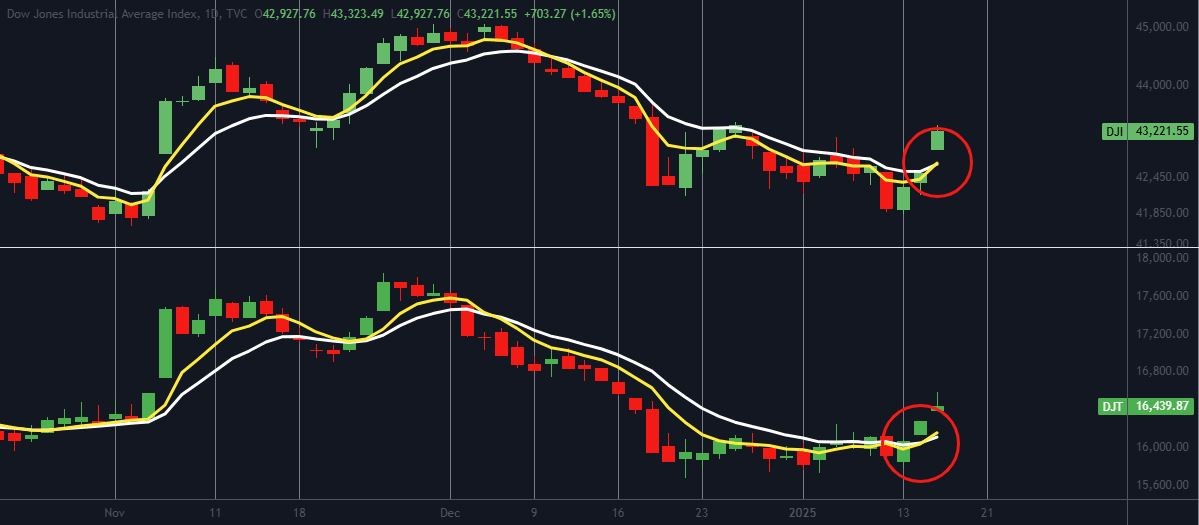
Dow Theory suggests that the stock market is in an upward trend when the Dow Jones Industrial Average (DJI) rises above a previous key high and the Dow Jones Transportation Average (DJT) does the same. This idea, known as "averages confirming each other," means that for a market trend to be valid, both industrial and transportation stocks must move in the same direction. The logic is simple: industrial companies make the goods, and transportation companies deliver them. If both are performing well, it signals a healthy, growing economy.
Source: www.tradingview.com
Following improvements in the core CPI, the gap opening has triggered a positive crossover in the Dow Jones Transportation Average (DJT) EMAs (shown in the bottom chart), while the EMAs for the Dow Jones Industrial Average (DJI) appear poised for a similar crossover (top chart). If this crossover occurs and a clear separation develops, it could signal a bullish Dow Theory pattern. In this context, a decline in the 10-year yield would be favourable, supporting a positive outlook for stocks. However, as noted earlier, moderation in the core PCE (the preferred inflation gauge), a healthy Q4 earnings season with good forward guidance, and a responsible approach to tariff implementation will be essential to facilitate a drop in yields.
Conclusion
In conclusion, while the stock market has demonstrated resilience in the face of various economic challenges, key indicators suggest that caution is warranted. The SPX, Dow Jones Industrial Average, and Nasdaq all show signs of resistance at elevated levels, and the Federal Reserve’s recent interest rate stance adds to the complexity. The interplay between inflation, interest rates, and geopolitical factors, such as tariffs, continues to shape market dynamics. Investors should keep a close eye on critical support levels and be prepared for potential volatility. The upcoming earnings season and key economic data releases, particularly the Core PCE, will be crucial in determining the market's direction. A balanced approach that considers both the risks and opportunities will be essential for navigating the evolving landscape. As always, staying informed and agile will be key to making sound investment decisions.
Senior Market Specialist
Russell Shor
Russell Shor is a Senior Market Strategist at Tradu, having been promoted to the role in 2025 in recognition of his depth of insight and consistent delivery of high-impact market analysis. He originally joined FXCM in October 2017 as a Senior Market Specialist.
Russell holds an Honours Degree in Economics from the University of South Africa, is a certified FMVA®, and a full member of the Society of Technical Analysts (UK). With over 20 years of experience in financial markets, his work is renowned for its clarity, precision, and strategic value across asset classes.