
Shares
Nvidia stock in recovery mode ahead of earnings amid AI growth and tariff relief

Tariff pauses and strong demand for Nvidia’s AI chips - driven by continued Big Tech spending - have fuelled a broader Wall Street and NVDA recovery. This places Nvidia in a strong position ahead of a pivotal earnings report. However, trade uncertainty and potential pitfalls still loom.

Early 2025 challenges: Tariffs and AI disruptions impact Nvidia's performance
After a blockbuster 2024 - when Nvidia (NVDA) delivered the third-best performance in the S&P 500 - the new year began on a markedly different note. A series of adverse developments sparked concerns over demand for its semiconductors, pushing the stock to multi-month lows and an 18.9% decline between January and April.
The first major threat emerged from the runaway success of DeepSeek. Its low-cost artificial intelligence model raised doubts about the necessity of massive AI investments and Nvidia’s most advanced chips. It also accelerated the AI efforts of Chinese tech giants like Alibaba and Baidu, casting fresh uncertainty over US Big Tech’s dominance.
Then came so-called "Liberation Day” on April 2, when President Trump announced sweeping tariffs on key trading partners. These included steep levies on imports from markets such as Taiwan (32%), where TSMC manufactures Nvidia’s chips [1]. The tariffs added to existing export controls that restrict shipments of advanced technology to China.
Trump’s disruptive trade policies have dented business and consumer confidence, contributing to a contraction in the US economy during Q1. These developments have intensified concerns over AI investment and semiconductor demand. Furthermore, Nvidia’s February quarterly results had underwhelmed markets. Despite strong AI demand and otherwise impressive revenues, the pace of growth continued to ease. Crucially, managements expect further deceleration in the soon to be reported quarter (Q1 FY26). [2]

Tariff pauses and AI investments fuel optimism
The negativity started to fade, giving way to renewed optimism around Nvidia’s prospects, thanks to a series of favorable developments. Fears of a tariff-driven recession and plunging US markets triggered the return of the "Trump Put", as the administration dialled back tariff plans and sought to negotiate with trading partners.
On 9 April, the US President reduced his reciprocal tariffs to a baseline of 10%, with a 90-day pause - although tariffs on China were increased [3]. Further relief arrived for tech giants like Apple and Nvidia, as smartphones, chips, and other electronics were exempted from these tariffs. [4]
The good news continued: the US and China announced an agreement to lower previously prohibitive tariffs by 110% for 90 days [5]. In the same week, the administration rescinded the Biden-era AI Diffusion Rule, which restricted access to AI chips [6]. The move sparked hopes for a more export-friendly regime. Nvidia also confirmed the sale of 18,000 AI chips to Saudi Arabia - the first in what is expected to be several hundred thousand. [7]
Additionally, US tech giants maintained their commitment to increase their AI spending this year and much of that will go towards Nvidia’s chips. Meta raised its capital expenditures to $64–72 billion, an increase of at least 63% y/y [8]. Alphabet reaffirmed a planned 47% rise in capital spending, to $75 billion [9]. Microsoft expects further growth in the fiscal year beginning July, from the current $80 billion, albeit at a more moderate pace [10]. Even if the power needed for AI training declines, increased AI competition can spur AI proliferation and boost the need for inference.
Learn more about our stocks offering
Nvidia Stock in recovery mode ahead of earnings
These pivotal developments have led to a broader Wall Street recovery this month. Shares of Nvidia have covered the previous losses, trying to follow Magnificent Seven peers Meta Platforms and Microsoft. The news and volatility have reenergized trading activity on Nvidia, with volume among clients* rising in April to the highest in almost a year.
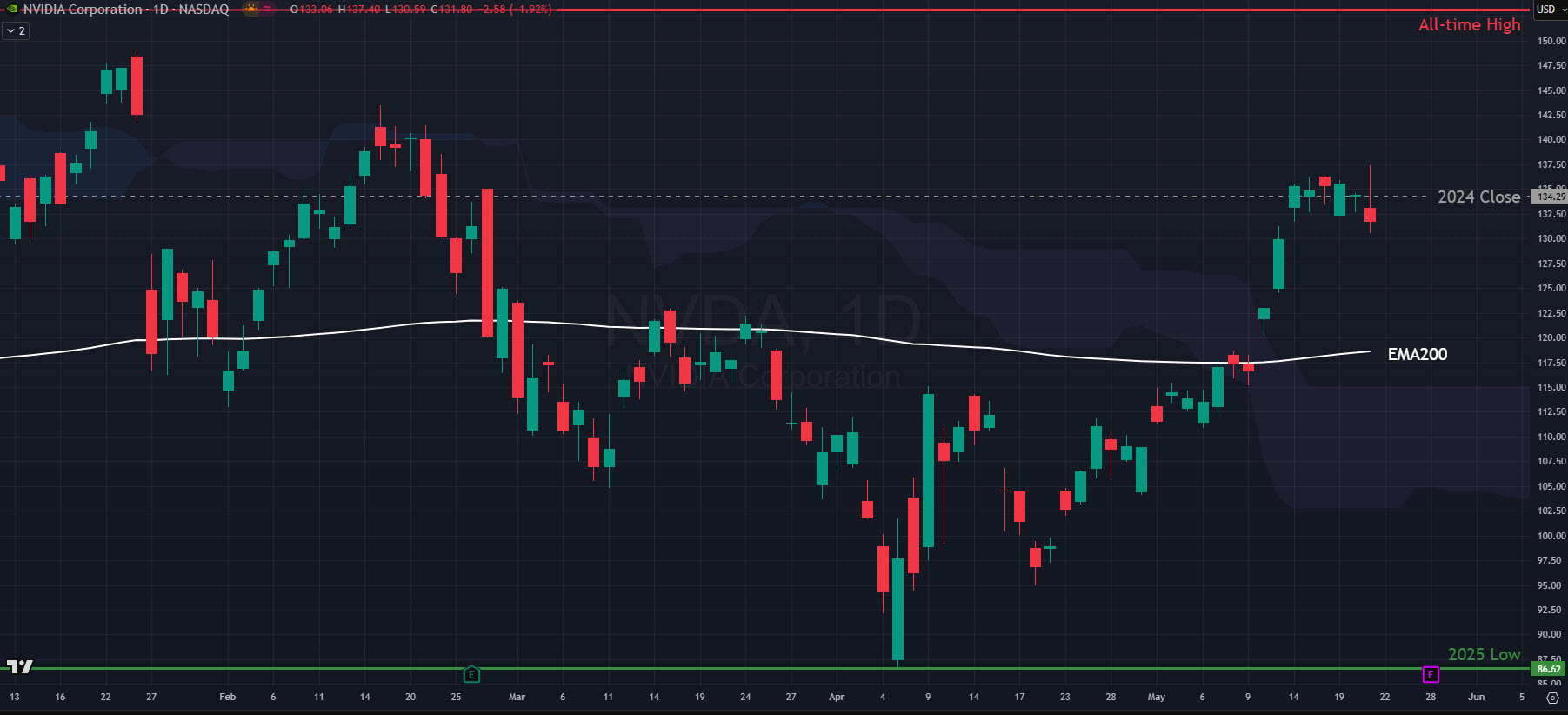
NVDA is now back on track for new 2025 highs. Strong Q1 FY25 results and guidance on Wednesday May 28 could provide the basis for further gains. However, volatility and pitfalls are set to persist. This can push shares back below the EMA200, negate the bullish bias, and keep the 2025 lows in play.
Source: www.tradingview.com
Despite Nvidia’s AI dominance and strong revenue expansion, the company expects further deceleration. The previous earnings were not well-received by markets, exacerbating the stock’s decline. Similar reaction after Wednesday’s report would not be surprising given the macroeconomic uncertainty and fears over US debt levels looming over Wall Street.
The AI Duffusion Rule is scrapped but authorities still process a new framework and Nvidia has already flagged a $5.5 billion from export restriction to China [11]. Tariffs have been lowered, but only temporarily and are still much higher than before Trump’s return to the White House. These lingering uncertainties continue to cloud the outlook for the global economy and the pace of AI adoption.
*Stratos clients.
Senior Financial Editorial Writer
Nikos Tzabouras
Nikos Tzabouras is a graduate of the Department of International & European Economic Studies at the Athens University of Economics and Business. With extensive experience in market analysis and a strong foundation in international relations, he brings a unique perspective to financial markets. Nikos emphasizes not only technical analysis but also on fundamentals and the growing influence of geopolitics on financial trends.
As a Senior Financial Editorial Writer, he delivers comprehensive and forward-looking insights across a wide range of asset classes, including equities, commodities, and currencies. His work explores how macroeconomic events, political developments, and global policies impact market dynamics, providing readers with a deeper understanding of both short-term movements and long-term trends.