
Shares
Top 10 Stocks for Q3 2025 – Part 1

Apple, Xiaomi, Renk, First Solar, and Meta are among the top stocks to watch in Q3 2025. Global equities face a challenging environment, with tariffs uncertainty and geopolitical tensions complicating the outlook. Yet, defence stocks are gaining from rising military budgets, while the Artificial Intelligence boom continues to fuel investor optimism.
Global equities face challenging macroeconomic environment
The return of President Trump to the White House has ushered in a period of heightened uncertainty, as a wave of sectoral and reciprocal tariffs upends established trade regimes and disrupts intricate global supply chains. While the temporary suspension of many of these levies - amid negotiations with trading partners - has helped to mitigate some of the immediate impact, it has also added to the overall unpredictability.
These tariffs can dampen global growth, particularly with the world’s two largest economies - China and the United States - at the epicentre. This uncertainty has introduced volatility into global equity markets, as rising input costs and inflationary pressures weigh on corporate margins and suppress demand.
Geopolitical tensions are compounding the fragility. The conflict between Israel and Iran threatens to destabilise the strategically vital Middle East energy corridor, while the protracted war in Ukraine continues to cast a shadow over European stability. The hostilities have the potential to push oil prices higher, adding to the economic headwinds created by tariffs.
Despite these adversities, major global equity markets have managed to rebound from the Liberation Day shock, running a profitable year. Wall Street’s resurgence has been driven in large part by renewed optimism around artificial intelligence (AI). Big Tech continues to invest heavily in AI infrastructure, bolstering demand for semiconductors and helping fuel a rally in the utilities sector.
China’s economy continues to wrestle with persistent challenges - including weak domestic consumption, tariffs, and advanced technology restrictions. Nonetheless, growth in clean energy and AI remains a bright spot. The low-cost AI model developed by DeepSeek has triggered a paradigm shift, spurring accelerated investment from Chinese tech giants such as Alibaba and Baidu. Meanwhile, BYD continues to lead China’s electric vehicle (EV) revolution, remaining the top seller of electrified vehicles for three consecutive years.
In Europe, governments are working to offset the impact of tariffs and revitalise sluggish economic growth through a renewed focus on defence spending. This rearmament push, spurred by geopolitical concerns, provides a significant boost to the region’s defence sector, benefiting major contractors across the continent.
As the third quarter gets underway against a challenging and volatile backdrop, we take a look at some of the stocks that will be in our radar over the coming months. In this instalment of a two-part series, we focus on firms leading the charge in AI, smartphone titans grappling with tariff challenges, Europe’s sprawling defence industry, and the US solar sector facing adversities from Trump’s policies. You can read Part 2 here.
Apple: A tech giant facing existential threats
Apple is one of the most valuable companies in the world, with a market capitalisation in the trillions. It is among the largest smartphone makers globally, with an installed base that exceeds 2 billion devices. It is renowned for a seamless and sticky ecosystem of hardware, software and services.
This has been a tough year for Apple as it contends with a combination of existential threats: tariffs, regulatory scrutiny, and a lag in the AI arms race. With its manufacturing performed “primarily” in mainland China and other Asian countries , it is particularly exposed to President Trump’s disruptive trade policies. CEO Tim Cook warned of an expected $900 million increase in costs this quarter during the last earnings call . While temporary exemptions for smartphones and paused levies offer some reprieve, the US President has threatened Apple with 25% levies on non-US made products , leaving it with limited options.
At the same time, its ‘Walled Garden” business model is under siege. A recent court ruling in the US - stemming from the ongoing Epic Games case - mandated that Apple allow third-party web links and external payment options in its App Store . This could derive it form lucrative commissions. In the EU, Apple has already made concessions, reducing App Store fees and opening the platform to comply with the Digital Markets Act (DMA).
Apple’s AI shortcomings were laid bare at this year’s WWDC, as it deferred the pivotal Siri upgrade to the coming year . New features like Live Translation are a mere catch up with Android rivals. This lag has failed to spark a much-needed device upgrade cycle that would lift sluggish revenue growth. This is also indicative a broader lack of innovation, whereas rivals press on. Samsung expands its wearables line up and Xiaomi advances on the EV front after last year’s successful entry.
China is another a key concern. Tense Sino-US relations and weak local demand have weighed on performance, with Apple’s sales in China declining more than 2% y/y in the March quarter.
Nonetheless, Apple retains significant strategic advantages. With deep financial reserves and access to vast user data, it can make headway in AI. Importantly, it may not need to lead the innovation curve to succeed. Its enormous and loyal user base, coupled with its entrenched ecosystem, can support sustained demand and ongoing growth in Services revenue. Furthermore, while tariffs are damaging, they could hinder Apple’s competitors as well - potentially positioning Apple as a relative beneficiary.
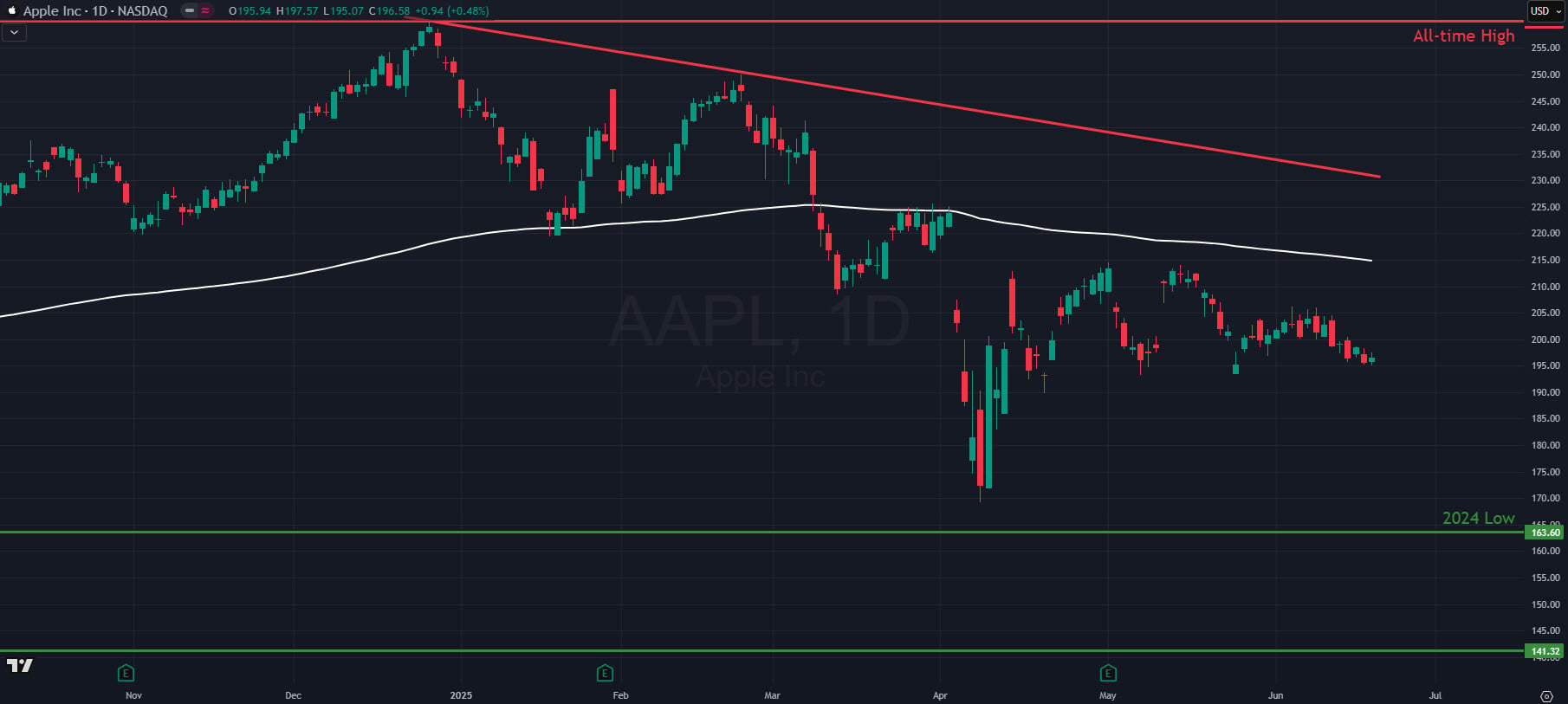
Shares of Apple are down over 20% year-to-date (as of the June 18 close), weighed by the mounting adversities, which makes AAPL vulnerable to deeper declines. Yet, the lower valuation can renew the appeal of the stock as Apple maintains a strong market and financial position, providing scope for recovery.
Source: www.tradingview.com
Learn more about our stocks offering.
Xiaomi: Technological advancements and EV push
Founded in 2010, the Chinese tech company has quickly emerged as a top smartphone maker globally, ranking third behind Apple and Samsung in 2024 according to Canalys . It is also known for a wide range of smart devices, from wearables to home appliances like robot vacuums, with an install base of 718.8 million as of the end of March.
Xiaomi is expanding its activities into the electric vehicle market (EV) as it works towards building a fully connected, deeply integrated “Human x Car x Home Smart” ecosystem. Its SU7 smart sedan has seen robust demand, with 258,000 units sold in just over a year. The company plans to launch a new SUV model this summer, targeting Tesla’s Model Y and aiming to significantly boost deliveries in 2025.
In a bid to increase technological self-reliance and compete with industry leaders, Xiaomi recently unveiled its own custom 3nm flagship chip - clearly taking aim at Apple. It is also investing in artificial intelligence, developing its proprietary MiMo large language model amid intensifying competition in the AI space.
The combination of technological innovation, a broad product range, and most importantly the high-profile entry into EVs has translated into strong financial performance. Total revenue surged by 47.7% y/y to a record RMB 111.3 billion (approximately USD 15.5 billion). Notably, the “EV, AI and other initiatives” segment grew by 64.5% y/y, generating RMB 18.6 billion in sales.
Despite these achievements, Xiaomi faces several external challenges. Persistently weak consumer demand in China can hurt sales, while a fiercely competitive domestic and global market can erode profit margins. Additionally, threats to the global economy and supply chains form disruptive trade policies can hurt global demand and hinder its expansion efforts.
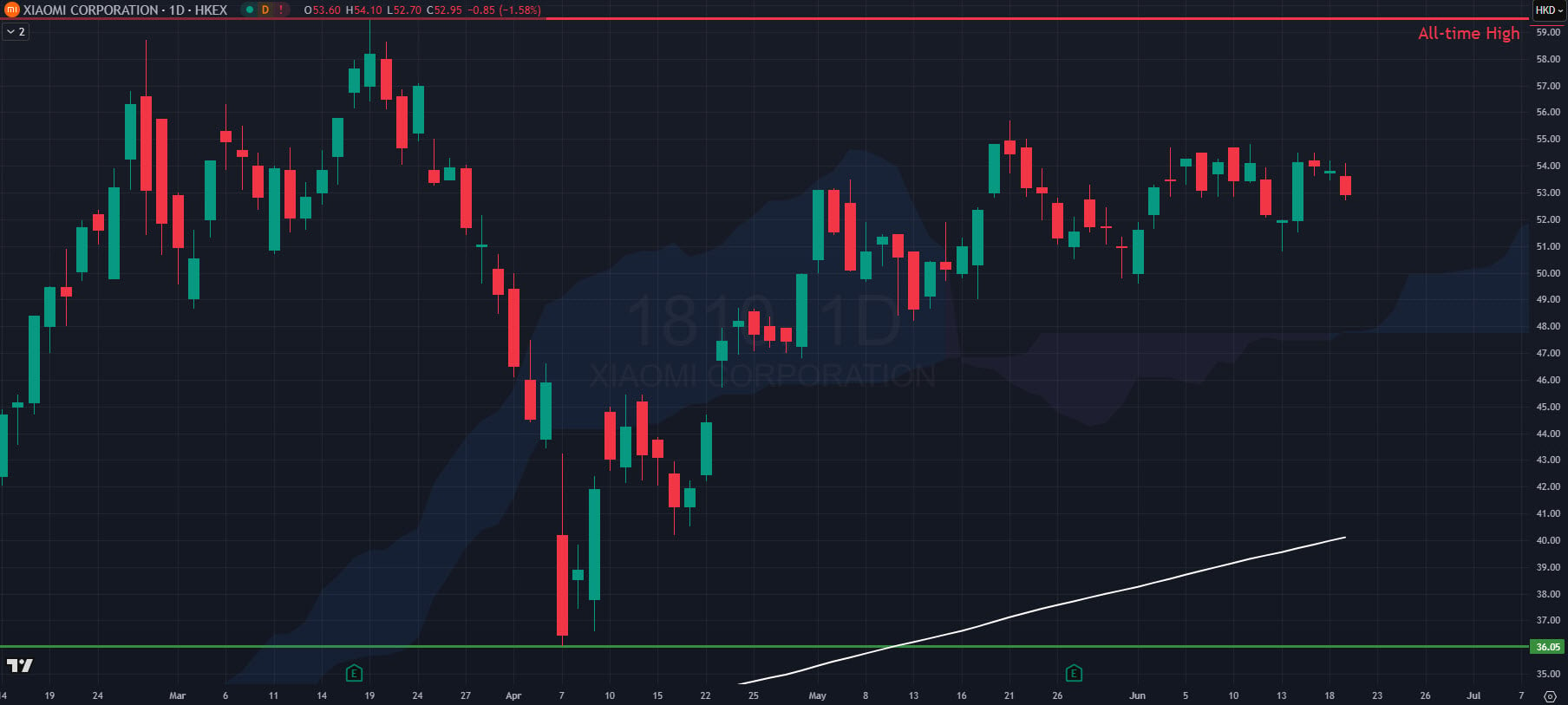
Shares of Xiaomi surge over 50% in 2025 (as of the June 19 close), having reached all-time highs earlier in the year. Its strong momentum, driven by innovation and diversification, keeps the stock on an upward trajectory. However, the broader macroeconomic environment remains fragile, and concerns over Xiaomi’s elevated valuation could leave it vulnerable to future pullbacks.
Source: www.tradingview.com
Renk: A dark horse in Europe’s defence supercycle
The German manufacturer specialises in propulsion and drivetrain systems—including engines, transmissions, and suspensions. While its technologies have civilian applications, the company’s primary focus is on military equipment. Renk operates across 20 manufacturing, support, and maintenance sites worldwide, employing around 4,000 people.
Global trade antagonism, Trump’s alienation of traditional European allies, ongoing war in Ukraine and flare up in the Middle East with the Israel-Iran conflict create a volatile and uncertain geopolitical environment. This confluence of instability is driving a sharp increase in military expenditure on both sides of the Atlantic. In the United States, President Trump is seeking a record defence budget as he pursues his “Golden Dome” initiative . Meanwhile, Europe is undergoing a historic rearmament shift, with the European Commission targeting nearly €800 billion in military investment over the next four years . The UK is also set to raise defence spending to 2.6% of GDP from 2027 .
This environment paves the way for a sustained defence supercycle, with military contractors emerging as key beneficiaries - particularly in Europe. Major players like Rheinmetall, Leonardo, and BAE Systems have seen both financial benefits and share prices surge, as highlighted in our Top 5 Defence Stocks for Q2 2025 report. Renk, though less well-known, is also standing out. The company posted an impressive first quarter, with order intake soaring by 163.5% y/y and a record order backlog of €5.5 billion, driven by what it described as a “strong defence business”. Looking ahead, Renk forecasts a 14% increase in revenue and expects adjusted profits to rise by at least 11% .
Despite the tailwinds, risks remain. The execution of Europe’s ambitious rearmament plans could face obstacles, given the continent’s fragmented defence sector and coordination challenges. Additionally, trade disruptions -particularly those involving critical rare earth minerals - pose potential supply chain threats. Furthermore, US President Trump has a stated desire to bring current military conflicts to an end. If realised, it could curb the need for defence spending.
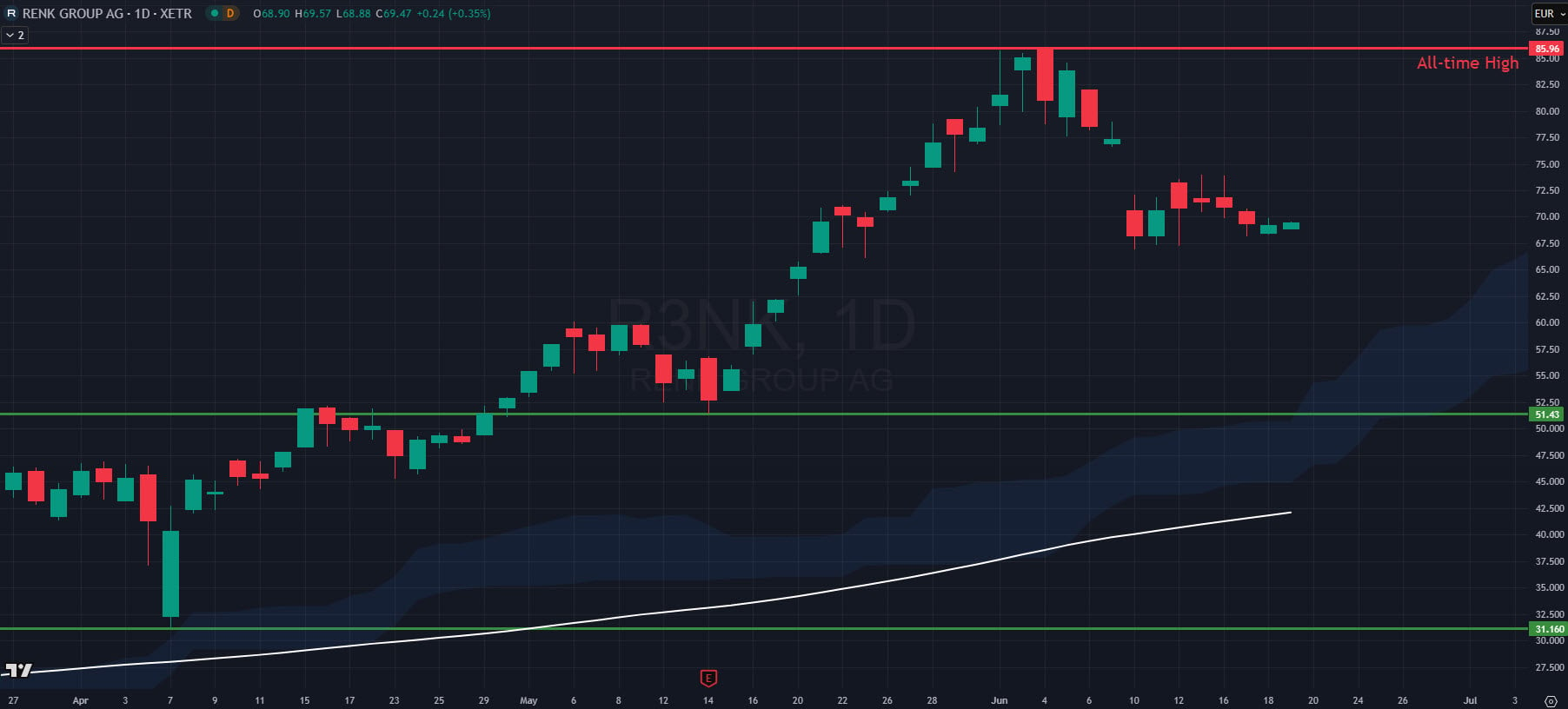
Shares of Renk (R3NK) have more than quadrupled this year (as of the June 18 close), making it standout performer in the sector. With the defence boom continuing, the rally may well extend to new record highs. However, the magnitude of the gains has raised concerns about overvaluation, making the stock potentially vulnerable to a correction.
Source: www.tradingview.com
First Solar: Navigating shifting clean energy policies
First Solar is the largest photovoltaic manufacturer in the United States, delivering over 14 gigawatts of solar modules last year across more than 40 countries. In an industry dominated by Chinese-made panels, First Solar stands out with a diversified manufacturing footprint spanning the United States, India, Malaysia, and Vietnam.
Trump’s return to the White House can undermine the renewable energy industry, as he has pledged to undo his predecessors green new deal, while committing to fossil fuels. His One Big Beautiful Bill that has cleared the House and is under consideration in the Senate makes good on this promise, cutting tax credits from wind and solar electricity production . On top of that, his tariff-heavy trade approach risks fuelling inflation, increasing borrowing costs, and weakening consumer sentiment. These are conditions that could dampen investment and broader demand.
First Solar’s revenue grew by 6.35% in Q1 2025, but that marked its slowest pace in three years. Net income also declined significantly, with the CEO attributing the weakness to challenges stemming from the new tariff regime. Management revised its 2025 guidance downwards, forecasting revenue between $4.5 and $5.5 billion.
Nevertheless, the company remains cautiously optimistic. The CEO reaffirmed confidence in long-term growth prospects, and even the lowered outlook suggests at least 7% y/y growth. Importantly, steep tariffs on low-cost Southeast Asian solar cells may benefit domestic manufacturers such as First Solar by levelling the playing field . And although the proposed tax bill is broadly unfavourable to renewables, it preserves most incentives for domestic manufacturing - potentially giving First Solar a relative advantage.
Despite current policy uncertainties, the structural demand story remains intact. The US Energy Information Administration (EIA) expects solar power generation to continue growing through this year and into next , fuelled in part by the energy demands of a rapidly expanding AI data centre ecosystem.
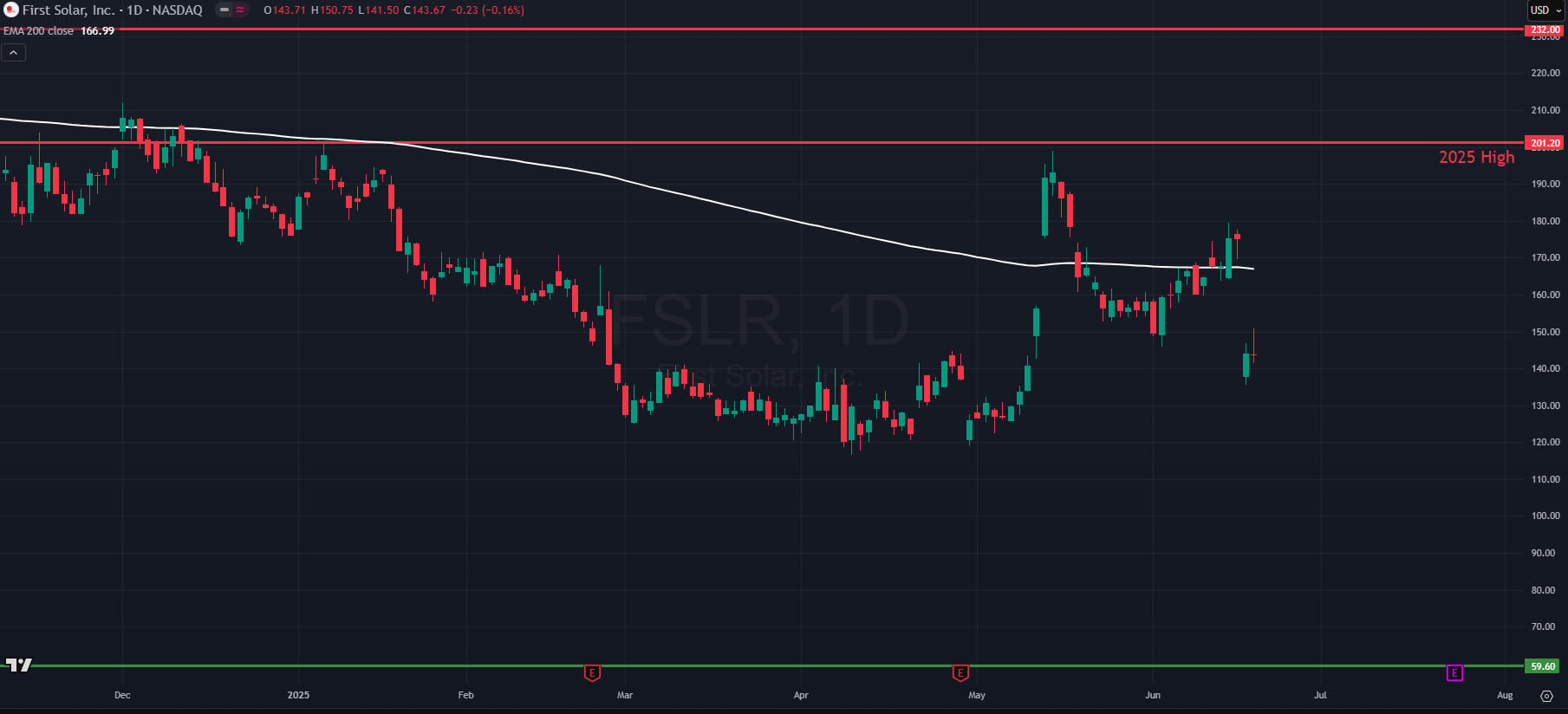
Shares of first solar, which is down nearly 20% year-to-date (as of the June 18 close). The unfavourable shift in clean energy policies under President Trump, leaves FSLR exposed lower lows. Yet, First Solar show resilience, which can aid a recovery and new 2025 high.
Source: www.tradingview.com
Meta Platforms: Pushing for AI leadership with massive investments
Meta is the parent-company of Facebook, which launched in 2004 and changed the way people connect. Its social media empire also includes Instagram, WhatsApp, and Threads. Under the leadership of CEO Mark Zuckerberg, Meta has pivoted decisively towards Artificial Intelligence, positioning itself as a frontrunner in the field.
The tech giant plans to spend $64-72 in 2025 – an at least 63% jump from the prior year - as it builds data centres to support the AI push . It develops its own Llama large language model (LLM), it has launched a Meta AI assistant and integrates the technology to its wearables business. Mark Zuckerberg envisions a future beyond smartphones, with smart glasses becoming the dominant user platform. Additionally, Meta is also trying to benefit from the defence supercycle amid heightened geopolitical uncertainty, partnering with Anduril to build XR products for military use . Crucially, it leverages AI in its advertising business – the main source of revenue.
While many tech peers still struggle to show return of investment, Meta has done a better job at showcasing the benefits of the AI work on its business. During the lats earnings call, Mark Zuckerberg once again highlighted how AI drives user engagement and time spent on its platforms, as well as better results for advertisers.
The social media giant is also exploring monetisation options for WhatsApp, its widely used messaging platform with over 3 billion active users. The inclusion of advertisements and subscription options represent a strategic step forward, helping to offset the surging costs associated with AI development.
Meta’s rising capital expenditures can worry investors as revenue growth slows - a trend that could continue in the second quarter as Meta expects a deceleration in sales growth. The current macroeconomic backdrop, shaped by President Trump’s tariffs, presents headwinds for the advertising market and could weigh on Meta’s earnings. CFO Susan Li flagged this concern during the last earnings call, citing “some reduced spend” from Asia-based e-commerce firms.
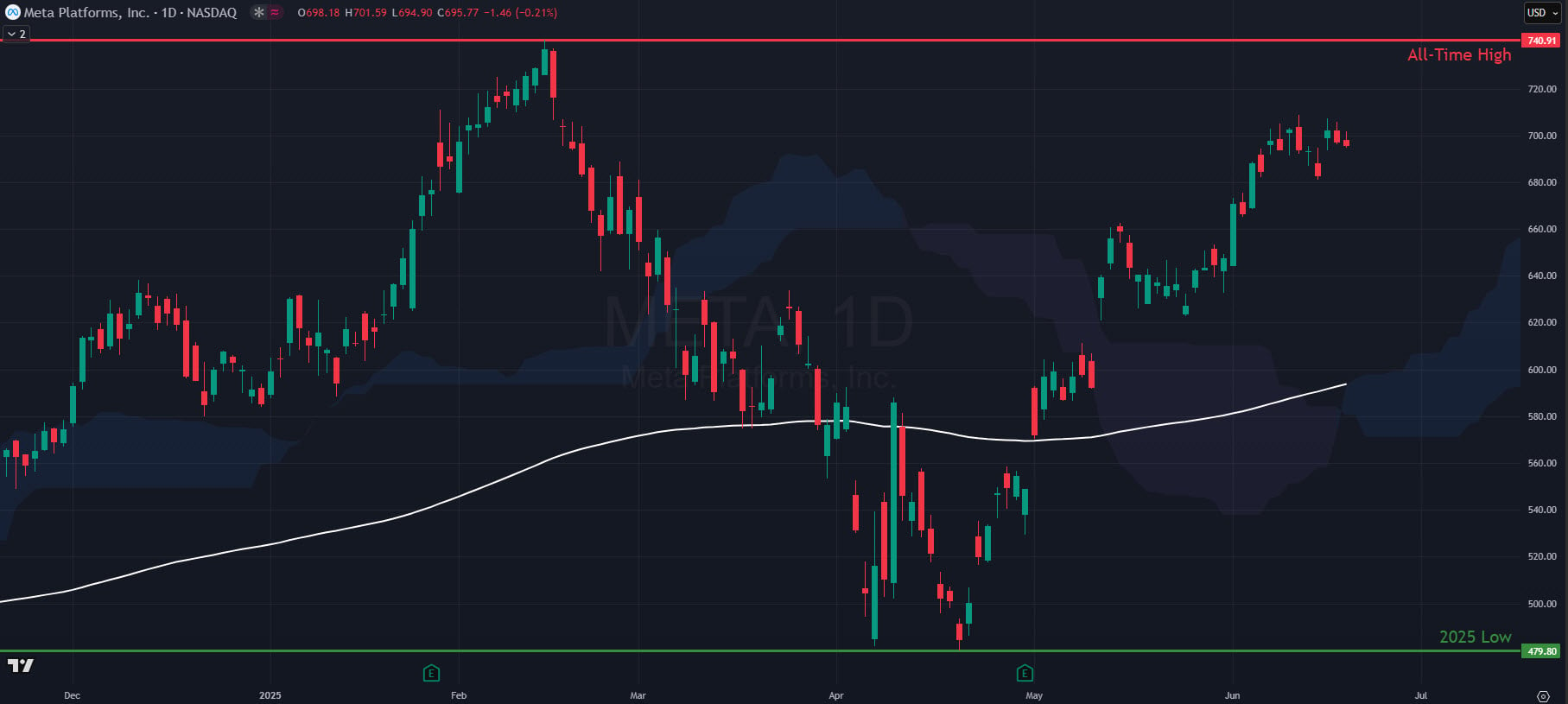
Shares of Meta are up 7.5% year-to-date, after overcoming the declines sparked by the DeepSeek breakthrough and the reciprocal tariffs announcement. This makes it the top performer along with Nvidia among the Magnificent Seven croup. Meta is well positioned for new record highs but remains vulnerable to corrections given the uncertain macro environment and intensifying AI competition.
Source: www.tradingview.com
Senior Financial Editorial Writer
Nikos Tzabouras
Nikos Tzabouras is a graduate of the Department of International & European Economic Studies at the Athens University of Economics and Business. With extensive experience in market analysis and a strong foundation in international relations, he brings a unique perspective to financial markets. Nikos emphasizes not only technical analysis but also on fundamentals and the growing influence of geopolitics on financial trends.
As a Senior Financial Editorial Writer, he delivers comprehensive and forward-looking insights across a wide range of asset classes, including equities, commodities, and currencies. His work explores how macroeconomic events, political developments, and global policies impact market dynamics, providing readers with a deeper understanding of both short-term movements and long-term trends.