
Shares
Xiaomi EV-powered rally faces earnings test

Xiaomi is enjoying a blockbuster year, driven by the strong performance of its entry into the electric vehicle (EV) market, where it is challenging Tesla and making major gains in China. At the same time, the Chinese tech giant is advancing in artificial intelligence with its own large language model (LLM) and launching premium smartphones and tablets powered by its proprietary 3nm XRING chipset. These innovations have boosted both its share price and revenues, but challenges remain, including fierce competition and trade disruptions.

Xiaomi heads into Q2 earnings with a strong hand but risks loom
The Chinese smartphone giant is enjoying a blockbuster year, largely thanks to the runaway success of its electric vehicle (EV) business. Achieving what Apple could not and going head-to-head with Tesla, Xiaomi launched its first EV last year, targeting the Model 3. In July, it expanded its line-up with the highly anticipated YU7 SUV, which undercuts Tesla’s Model Y on price. The new vehicle received nearly 300,000 orders within the first hour [1], helping to push total Q2 deliveries past 83,000 [2] – a new quarterly record.
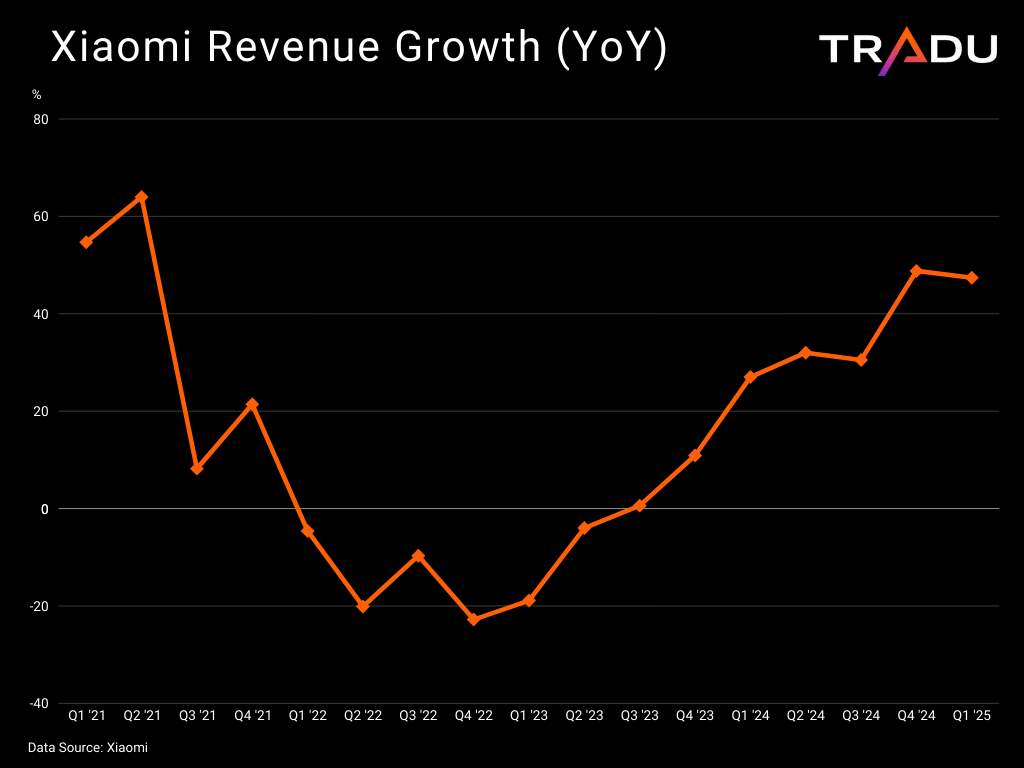
Its entry into the EV market, which diversifies an already extensive product range, has acted as a powerful revenue accelerator. Growth surged to an eye-watering 48.8% in Q4 – the highest in nearly four years. Xiaomi maintained an enviable pace in the first quarter of the current year, with its EV segment generating RMB 18.1 billion (around USD 2.5 billion) – more than 15% of total sales in that period. While ramping up production is cost-intensive, it has not weighed on overall profitability, which rose to fresh records [3]. Segment losses narrowed in Q1, and according to Reuters, the company’s founder and CEO expects the EV arm to turn a profit in H2. [4]
Xiaomi’s success is not solely down to its EV push. It is also the result of broader technological advancements, a premiumisation strategy, and its commitment to a broad product portfolio. The range spans EVs, smartphones, and home appliances such as robot vacuums, with 718.8 million monthly active users worldwide. The company continues to push the envelope with innovations such as its in-house large language model (MiMo) and AI-powered smart glasses. It is also targeting the higher end of the consumer electronics market, with the Pad 7 Ultra tablet and 15S Pro smartphone among the latest additions. These devices feature Xiaomi’s own XRING 3nm flagship chip – a move reminiscent of Apple’s strategy – as it seeks greater self-reliance in an era of global trade tensions.
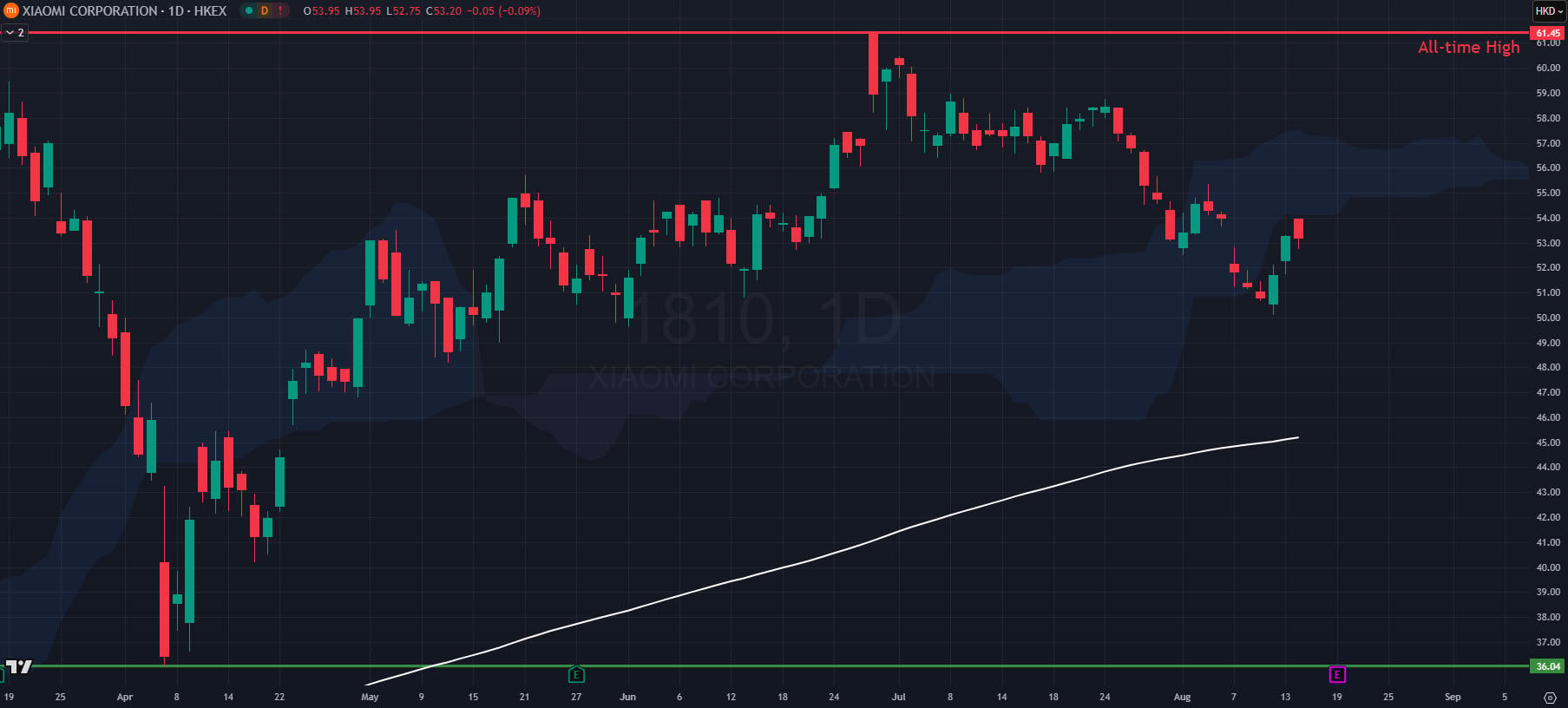
This rapid pace of innovation, combined with an expansive ecosystem, has turbocharged its financials and propelled the stock to new all-time highs earlier this year, with gains of more than 50%. Strong EV sales could help sustain high revenue growth in Q2, but the lofty valuation raises the stakes for Tuesday’s earnings release.
Source: www.tradingview.com
Despite Xiaomi’s impressive achievements, risks remain. Persistently weak consumer demand in China could weigh on sales, particularly as the boost from government subsidies tapered off in Q2. Mainland China smartphone sales grew just 3% [5], and Xiaomi slipped to fourth place according to Canalys, while global shipments were flat. [6]
Demand may not be an immediate concern for Xiaomi’s EVs, but fulfilling orders could prove challenging. Although the pace of production ramp-up is impressive, CEO Lei Jun has acknowledged the difficulties, even recommending rival models such as the XPeng G7 and Tesla Model Y for customers in a hurry [7]. Moreover, fierce competition in both domestic and global markets could erode profits, while tariffs and supply chain disruptions may hinder its global expansion plans.
Senior Financial Editorial Writer
Nikos Tzabouras
Nikos Tzabouras is a graduate of the Department of International & European Economic Studies at the Athens University of Economics and Business. With extensive experience in market analysis and a strong foundation in international relations, he brings a unique perspective to financial markets. Nikos emphasizes not only technical analysis but also on fundamentals and the growing influence of geopolitics on financial trends.
As a Senior Financial Editorial Writer, he delivers comprehensive and forward-looking insights across a wide range of asset classes, including equities, commodities, and currencies. His work explores how macroeconomic events, political developments, and global policies impact market dynamics, providing readers with a deeper understanding of both short-term movements and long-term trends.