
Indices
90 Days of Reckoning: Can Markets Withstand the Tariff Countdown?

Markets are navigating a delicate 90-day window with gold soaring and global stocks outperforming the S&P 500. While tariff negotiations, central bank tensions, and recession fears hang in the balance, technical indicators suggest a potential shift in capital flows. If global equities continue their momentum, we may witness a sustained rotation away from US shares. With key policy decisions on the horizon, the market remains volatile, and investors must stay nimble as sentiment can shift quickly.
Markets remain caught in a storm of uncertainty as geopolitical tensions, shifting monetary expectations, and a looming wave of tariffs continue to test investor resolve. While volatility has eased from its early April peak, sentiment remains fragile. A temporary reprieve on trade measures has offered some breathing room, but deeper anxieties around central bank independence, recession risks, and global equity rotation are far from resolved. Against this backdrop, technical signals and economic indicators are sending mixed messages, leaving investors to navigate an increasingly complex and dynamic landscape.
The 9.5% surge on 9 April provides an interesting benchmark for assessing the market’s performance. While the S&P 500 remains below that day's closing level, there are signs of progress toward reclaiming it. The market initially plunged on Monday after President Trump posted on Truth Social, labelling Fed Chair Powell a “major loser” and suggesting his “termination” couldn’t come soon enough. However, Trump later clarified that he had no intention of firing Powell, prompting a rally as investors collectively breathed a sigh of relief, reassured that the central bank would remain politically independent.
The market’s rebound was triggered by a 90-day reprieve on tariffs, and investors appear to be capitalising on the opportunity. That said, caution remains warranted. A Reuters headline on 12 April read, “Trump trade team chases 90 deals in 90 days. Experts say good luck with that.” It does seem an almost impossible task. However, certain countries are prioritised in these negotiations, and the market may be satisfied with progress on a select few during the 90-day freeze.
A pressing question is whether 90 days is sufficient for such complex negotiations. These discussions are inherently time-consuming, and a multifaceted narrative is emerging. China has warned that any country reaching a deal with the US at China’s expense will face retaliation. This follows reports that President Trump intends to pressure around 70 countries to reduce trade with China, citing concerns over currency manipulation and intellectual property theft.
Each day adds a new piece to the puzzle. President Trump recently signalled that US tariffs on China could be significantly reduced once a deal is reached — though not entirely eliminated. Many countries are now rushing to finalise agreements before the proposed tariffs take effect in July. A 10% tariff could theoretically raise $2.9 trillion in revenue, though retaliation and slower growth may reduce this figure to $1.6 trillion.
Another evolving development is China’s openness to trade talks following Trump’s signals on lowering tariffs. However, Beijing insists that negotiations cannot proceed under continued threats. Both sides are seeking to de-escalate tensions, with Treasury Secretary Scott Bessent anticipating progress despite deep-seated mistrust. A swift resolution remains unlikely, as China braces for a prolonged standoff and deepens ties with other nations.
In the meantime, the market remains sensitive to concerns around central bank independence and the progress of trade talks under the 90-day deadline. Should these anxieties remain contained, volatility is likely to stay muted. However, if tensions escalate, volatility will rise, spreading investor nervousness.
Market sentiment is extremely bearish, with the CNN Fear & Greed Index reflecting extreme fear. The VIX remains elevated at 27.8, though it has moderated from its peak of 60.13 on 7 April — between Liberation Day and the announcement of the tariff reprieve. Contrarian investors will be watching closely for signs of a potential reversal. While that is certainly possible, market uncertainty has not yet subsided.
If a contrarian opportunity is forming, the market may already have seen its bottom — at least for now. This week’s trading has stayed well above the weekly low and is currently higher than the week’s opening level, suggesting a tentative return of bullish sentiment after a lacklustre performance last week.
This situation will need to be monitored closely. Should optimism begin to take hold, the key question is whether it will be short-lived — fading before tariffs take effect on 8 July — or whether President Trump might delay implementation further if he has not secured the deals he is seeking.
Amid this uncertainty, the standout performer is gold. The precious metal is enjoying a stellar 2025, up 27% year-to-date, and briefly touched $3,500 this week before pulling back. Its surge reflects gold’s status as a safe-haven asset and the broader shift of capital away from turbulent markets.
The tariffs appear to have disrupted normal economic cycles. Soft data may offer clearer insights, as hard data is likely distorted by businesses front-running the tariffs, skewing results. These effects may not normalise until the second half of the year, complicating interpretation. If that proves true, the soft data could be pointing to a weaker second half. According to Polymarket.com, the probability of a US recession in 2025 currently stands at 53%.
Nonetheless, hard economic data remains resilient. While concerns about front-running are valid, clear signs of recession have yet to emerge. The ISM Services PMI continues to indicate expansion — a drop below 50 would signal contraction. Retail sales remain buoyant, and initial jobless claims have declined into April, suggesting labour market strength. Without a significant deterioration in these indicators, the onset of a recession is difficult to envision. Still, a meaningful rotation appears to be underway.
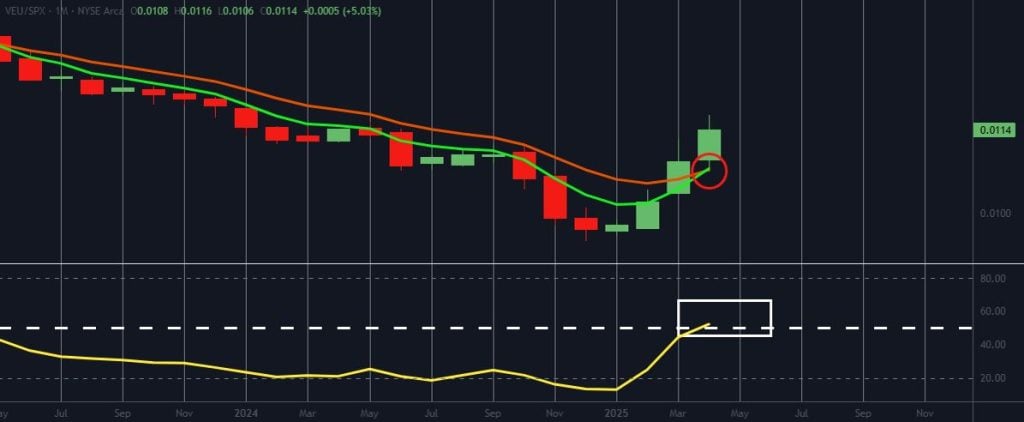
Since January 2025, global stocks excluding the US have been outperforming the S&P 500, with a notable lead so far in April — approximately 5% month-to-date. On the longer-term chart, the EMAs appear to be crossing bullishly (red ellipse), and the RSI is rising above 50 (white rectangle). These technical signals suggest that global equities may be entering a period of sustained outperformance relative to US shares. Much will depend on whether these trends hold. If they do, capital flows into global stocks could become more constructive.
As the countdown to the July tariff deadline continues, markets are walking a tightrope between hope and hesitation. The 90-day reprieve has given equities a temporary lift, but the underlying fragilities—strained global negotiations, questions around central bank independence, and a potential shift in economic leadership away from the US—remain unresolved. While technical indicators hint at renewed momentum in global stocks and gold surges as a safe-haven favourite, the road ahead is likely to be volatile. For now, resilience in the hard data offers some comfort, but the soft data's warning signs and elevated recession probabilities cannot be ignored. Investors would be wise to stay nimble, as policy shifts and market sentiment can turn sharply in either direction.
Senior Market Specialist
Russell Shor
Russell Shor is a Senior Market Strategist at Tradu, having been promoted to the role in 2025 in recognition of his depth of insight and consistent delivery of high-impact market analysis. He originally joined FXCM in October 2017 as a Senior Market Specialist.
Russell holds an Honours Degree in Economics from the University of South Africa, is a certified FMVA®, and a full member of the Society of Technical Analysts (UK). With over 20 years of experience in financial markets, his work is renowned for its clarity, precision, and strategic value across asset classes.