
Shares
Meta heads into Q2 2025 earnings with AI momentum

Mark Zuckerberg is determined to keep Meta Platforms at the forefront of artificial intelligence, investing heavily in chips, data centres, and strategic hiring. The recently announced AI Action Plan by President Trump may further support Big Tech’s ambitions. However, macroeconomic headwinds could pressure the digital advertising market - Meta’s core revenue stream - as the company prepares to report its Q2 2025 earnings. This, combined with soaring capital expenditures, may raise concerns among investors.

AI leadership bolstered by heavy investment – but concerns could emerge
Meta Platforms has firmly established itself as a leader in artificial intelligence (AI), with its strategic decision to open-source its large language model (LLM) validated by DeepSeek approach. This move was soon followed by other major players including Google, Baidu, and Alibaba, who have also begun to open up at least parts of their models. The tech giants are making substantial investments, which in turn benefit the semiconductor industry, as reflected in the latest results from ASML and TSMC.
Mark Zuckerberg appears determined not to be outspent or outmanoeuvred, ramping up spending and making strategic hires to remain at the forefront of AI. Meta is purchasing large volumes of chips and building data centres to support its growing AI ecosystem. This includes the META Assistant, advertising tools, and more. The company expects capital expenditure to rise by 63.1% to 83.5% year-on-year in 2025 [1], with Zuckerberg recently announcing plans to invest “hundreds of billions of dollars” in developing superintelligence [2]. President Trump’s AI Action Plan can facilitate Meta’s efforts, but also of its rivals [3].
As we highlighted in our Top 10 Stocks for Q3 report, Meta has done a better job than many rivals in showcasing the positive impact from its work and investments in AI. The CEO has consistently cited increased user engagement across its social media platforms and improved results for advertisers. In a strategic shift, Meta has also introduced ads and subscription tiers to WhatsApp [4]. With over three billion global users, this move could help support revenue while absorbing rising AI-related costs.
However, Meta’s expenditure is growing faster than its revenue. If this trend continues, it could raise concerns, particularly in today’s uncertain macroeconomic climate. The social media behemoth expects revenue to rise by 8.8%-16.5% y/y in the second quarter, leaving room for further deceleration. Meanwhile, capex growth will remain way faster and could even accelerate.

Tariff-related macroeconomic uncertainty can hurt ad sales - Meta’s main source of revenue. The cracks in the advertising business are already appearing, with marketing giants flagging macroeconomic risks during their latest results. Publicis warned of weaker client spending in the second half of the year [5]. WPP cut its 2025 forecast and now anticipates a 3% to 5% drop in sales [6]. Omnicom reaffirmed its full-year growth outlook of 2.5% to 4.5%, but this would still mark a slowdown compared to 2024 [7]. Meta’s CFO, Susan Li, also noted “some reduced spend” from Asia-based e-commerce firms during the last earnings call, signalling possible adverse shifts. [8]
For now, investors remain optimistic. Meta’s stock has gained more than 20% this year, placing it among the leaders of the Magnificent Seven and pushing it to new all-time highs. This strength could continue, given Meta’s prominent role in the AI space. However, the competition is intense, and should revenue momentum fade, it could spell trouble. From a technical standpoint, RSI divergence indicates the potential for a pullback. A break below the 38.2% Fibonacci level and the 200-day EMA would be required to negate the current bullish bias.
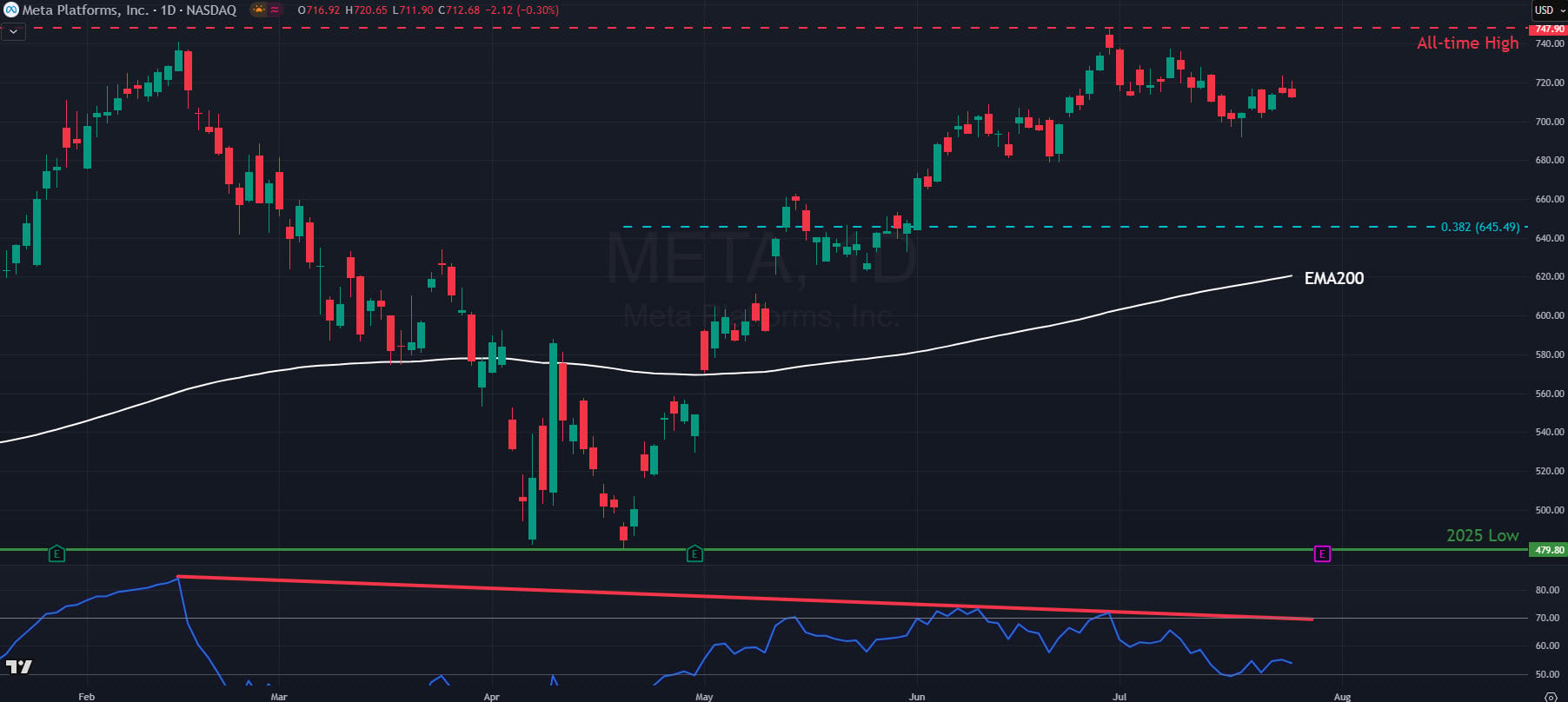
Source: www.tradingview.com
Senior Financial Editorial Writer
Nikos Tzabouras
Nikos Tzabouras is a graduate of the Department of International & European Economic Studies at the Athens University of Economics and Business. With extensive experience in market analysis and a strong foundation in international relations, he brings a unique perspective to financial markets. Nikos emphasizes not only technical analysis but also on fundamentals and the growing influence of geopolitics on financial trends.
As a Senior Financial Editorial Writer, he delivers comprehensive and forward-looking insights across a wide range of asset classes, including equities, commodities, and currencies. His work explores how macroeconomic events, political developments, and global policies impact market dynamics, providing readers with a deeper understanding of both short-term movements and long-term trends.