
Shares
Tesla hurts as BYD and other Chinese EV makers advance

EV deliveries from BYD and other Chinese startups surged in Q2 2025, highlighting their global appeal and technological innovation. In sharp contrast, US electric vehicle makers underperformed, and Donald Trump’s newly passed One Big Beautiful Bill threatens to make conditions even tougher by scrapping key EV incentives. Tesla’s sales fell significantly, underscoring ongoing struggles in its core automotive business, as Elon Musk turns to robotaxi development in hopes of unlocking future value.

Trump’s EV policy shift threatens market growth
The US EV industry faces fresh headwinds from Trump’s return to the White House, whose policies thraten the proliferation of elctric vehicles. The One Big Beautiful Bill, which passed through Congress on Thursday [1], delivers on his campaign promises by eliminating the Biden-era $7,500 tax credit for the purchase or lease of a new EV, as well as the $4,000 credit for buying a used one.
At the same time, tariffs are adding further pressure by squeezing profit margins. This creates a challenging macroeconomic backdrop, with stagflation risks, elevated interest rates, and weak consumer sentiment – all factors that can deter consumers from purchasing the typically higher-priced electric cars. Second-quarter sales figures reflect this difficult reality.
Rivian’s latest update on Thursday was telling. Startups like Rivian, which are still unprofitable, remain particularly vulnerable. The electric pickup and SUV maker delivered just 5,979 vehicles – the lowest level in three years and a steep 56.6% y/y decline [2]. Legacy carmaker Ford also struggled, with its pure EV sales dropping 31.4% y/y as customers continue to favour hybrids. [3]
Tesla deliveries highlight persistent challenges
Tesla could emerge as a relative beneficiary of tariffs and the end of EV incentives, thanks to its local manufacturing, solid profit margins, and dominant market position. However, it is not immune to these pressures, facing weakened consumer appeal and growing competition.
In the second quarter, Tesla saw a sequential rise in deliveries to 384,122 vehicles, supported by the broader availability of the refreshed Model Y [4]. This has sparked some optimism for a recovery in the second half of the year – particularly if a promised lower-priced model reaches the market. However, the figures still represent a 13.5% year-on-year decline, raising the risk of a second consecutive annual contraction in 2025. These results underline the continued automotive challenges discussed in our Top 10 Stocks for Q3 report.
Against these challenges, Elon Musk looks to self-driving to unlock value and June’s robotaxi launch marked an important milestone [5]. However, this is clearly a beta phase, while a broader rollout may require a more streamlined regulatory framework. The Musk-Trump feud that continued this week, raises concerns about the likelihood of such support.
BYD sales surge as Chinese EV makers continue to advance
In stark contrast to Tesla’s difficulties, BYD continues to thrive. The Chinese automaker saw pure battery EV sales jump 42.5% y/y in 2025, reaching a record 606,993 vehicles [6] – a quarterly feat Tesla has never matched. This puts BYD on strong footing to surpass Tesla in annual battery electric vehicle (BEV) sales, having narrowly missed doing so in 2024.
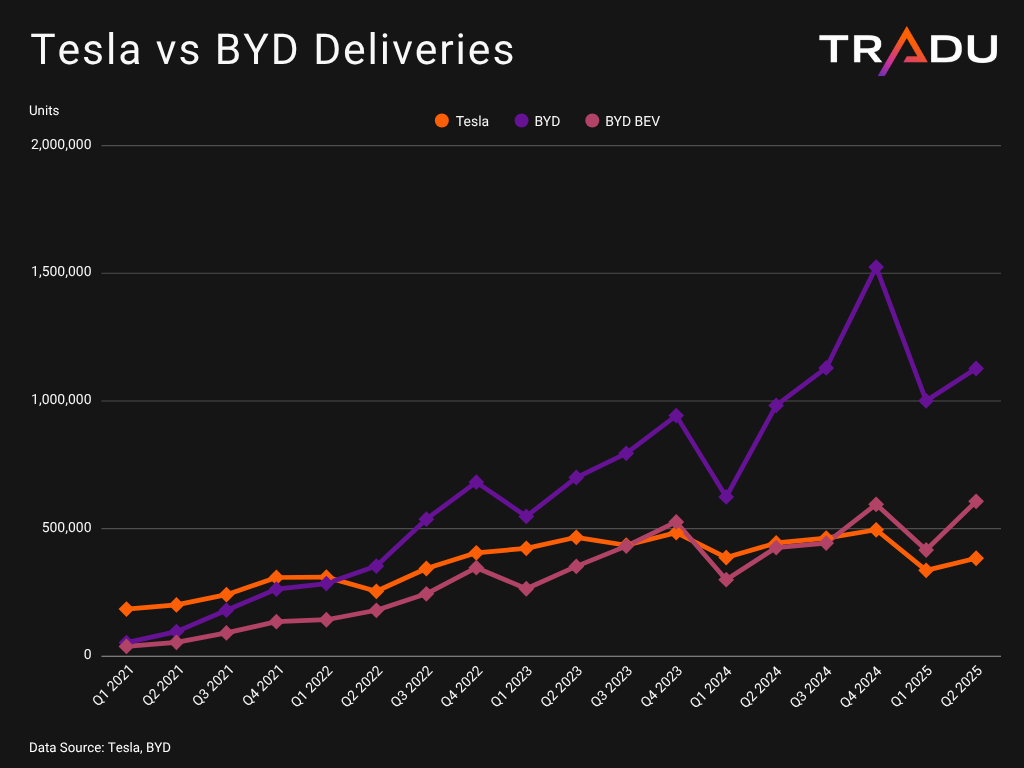
This surge comes on the back of technological breakthroughs that facilitate the proliferation of electric cars. Its latest EV platform enables up to 400 kilometres of range from just a five-minute charge, which can mitigate persistent range anxiety among consumers. It is also making progress on smart driving, making such features available to most of its models, aiming to populairse autonomous driving.
BYD’s success highlights China’s broader strength and innovation momentum in the EV space. Consumer electronics giant Xiaomi, which made a highly successful debut in the EV market last year, is now directly competing with Tesla. It delivered over 81,000 electric vehicles in the second quarter, reflecting both year-on-year and sequential growth. Its second model – the YU7 SUV, which undercuts the Model Y in price – could accelerate sales further, having received 289,000 orders within just the first hour of launch. [7]
Other prominent Chinese EV makers also posted strong Q2 results, supported by affordable models and cutting-edge technology. Xpeng set new records with 103,181 deliveries [8], while Nio also reached a new quarterly high, selling 72,056 vehicles [9]. Meanwhile, Geely's BEV sales more than doubled compared to a year ago. [10]
That said, Chinese automakers face fierce domestic competition and often rely on aggressive discounts to attract buyers, which can pressure profit margins. Additionally, their global ambitions may be limited by tariffs and escalating trade tensions.
BYD leads the way in EVs as Tesla loses its cachet
BYD has quickly established itself as a global EV leader through rapid sales growth and continuous innovation. Its domestic market position appears secure, its manufacturing and technological prowess is widely recognised, and its competitive pricing gives it a significant advantage. Moreover, its international expansion continues apace. However, risks remain, including a tough macroeconomic environment and tariff barriers.
Tesla on the other hand remains caught between a rock and a hard place: its core automotive segment continues to struggle, while autonomy has yet to materialise. Nonetheless, if executed right the high stakes-pivot to self-driving can unlock tremendous value.
Senior Financial Editorial Writer
Nikos Tzabouras
Nikos Tzabouras is a graduate of the Department of International & European Economic Studies at the Athens University of Economics and Business. With extensive experience in market analysis and a strong foundation in international relations, he brings a unique perspective to financial markets. Nikos emphasizes not only technical analysis but also on fundamentals and the growing influence of geopolitics on financial trends.
As a Senior Financial Editorial Writer, he delivers comprehensive and forward-looking insights across a wide range of asset classes, including equities, commodities, and currencies. His work explores how macroeconomic events, political developments, and global policies impact market dynamics, providing readers with a deeper understanding of both short-term movements and long-term trends.