
Commodities
Oil prices stay high on continued Israel-Iran conflict and supply fears

Crude oil prices remain elevated as Israel-Iran hostilities enter a sixth day, with former US President Donald Trump intensifying his rhetoric. The rising tensions are fuelling geopolitical uncertainty and raising fears of broader Middle East conflict and potential disruption to global oil supplies. However, no significant supply outages have been reported so far.
USOIL Analysis
Although the Middle East hostilities have been contained between Israel and Iran, their continuation for a sixth day reduces the likelihood of a quick ceasefire. Furthermore, the US President intensified his rhetoric against Iran on Wednesday after leaving the G7 summit early. After having denied that his early departure was linked to ceasefire efforts [1], a series of more aggressive social posts ensued.
In one, he claimed, “We now have complete and total control of the skies over Iran” [2]. He then added that “we know” where Iran’s Supreme Leader is and described him as an “easy target”, though he stated, “we are not going to take him out (kill!), at least not for now” [3]. He concluded this quick succession of posts by calling for Iran’s unconditional surrender. [4]
This marks a notable verbal escalation and a shift from the initial US State Department statement, which described Israel’s actions as “unilateral” and clearly denied any US involvement [5]. President Trump's use of the pronoun “we” suggests a potentially closer alignment with Israel than previously indicated, raising concerns about possible US military involvement. Israel Prime Minister Netanyahu appeared to be trying to draw the United States in during an ABC interview earlier this week, while also signalling openness to targeting Iran’s Supreme Leader. [6]
The Director of the International Atomic Energy Agency (IAEA) has confirmed some damage to Iran’s nuclear facilities from Israeli strikes [7]. However, a more serious blow may require US military action with long-range stealth bombers and “bunker-buster” weaponry.
Any American involvement could broaden the conflict and if the viability of Iran’s regime were seriously threatened, the risk of action at the Strait of Hormuz would rise. This vital chokepoint accounted for nearly a quarter of global oil flows in 2023, according to the US Energy Information Administration (EIA) . The risk of miscalculation has also increased, as recent strikes have killed senior Iranian officials.
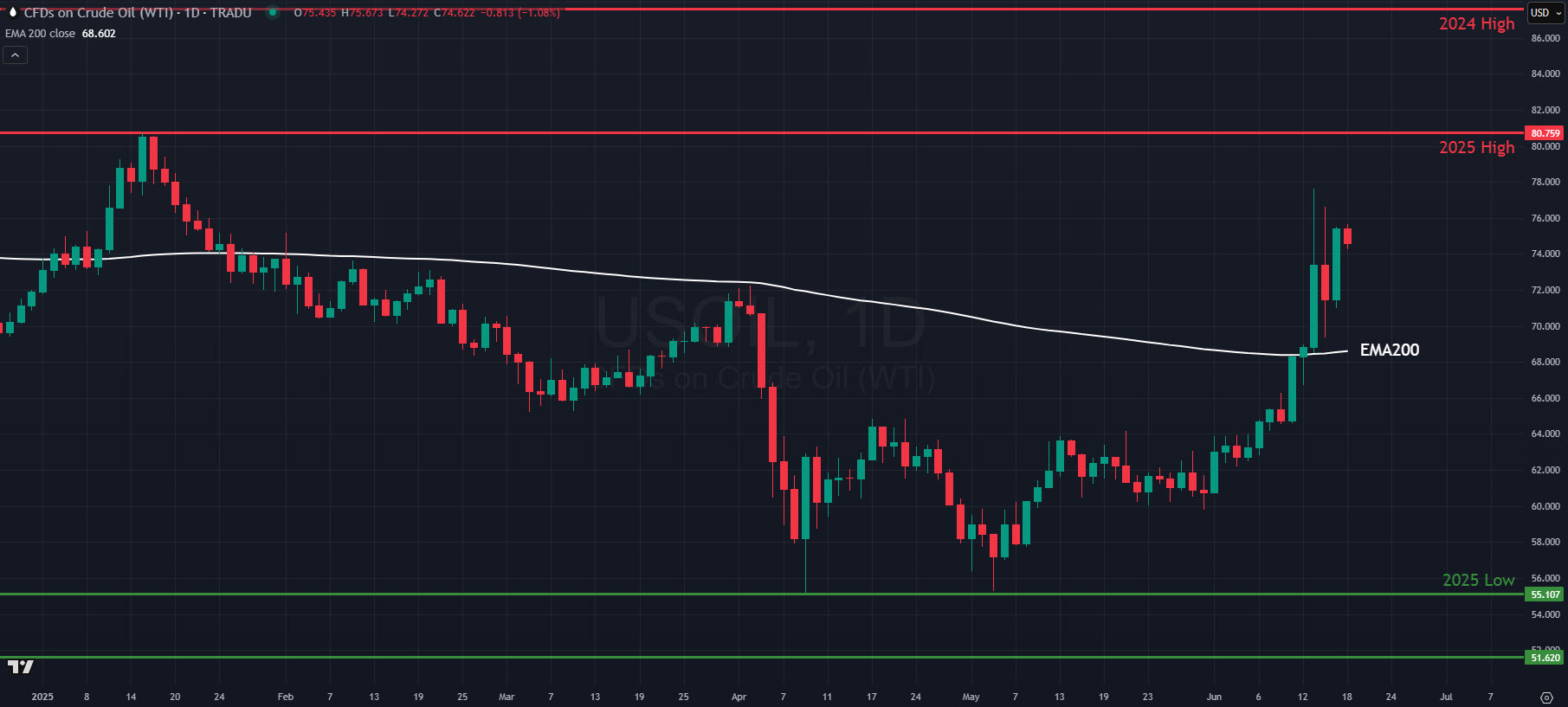
Oil prices remain elevated, underpinned by a high geopolitical risk premium. The ongoing conflict sustains supply concerns, while the escalation in US rhetoric further deepens market uncertainty. As a result, USOIL remains on a path towards fresh 2025 highs. However, the rally may lose momentum, and pullbacks could occur as the market digests unfolding developments.
Source: www.tradingview.com
Another surge in oil prices would require significant interruptions in flows. This has not materialized so far, while the closure of the Strait of Hormuz is a high-risk move and not easy to pull off. Meanwhile, the market remains well supplied: OPEC+ is returning oil to the market at a faster pace, while demand destruction risks persist due to the economic impact of tariffs. The International Energy Agency (IEA) expects supply growth to outpace demand in both 2024 and 2025. [9]
Importantly, there is no know US involvement in the strikes and the hostilities remain contained between Israel and Iran. The US President has an “America First” stance and a more isolationist approach that does not favour military actions. The shift in his rhetoric may just be a tactic to pressure Iran to stop the conflict and accept his terms.
Learn more about how to trade commodities.
Senior Financial Editorial Writer
Nikos Tzabouras
Nikos Tzabouras is a graduate of the Department of International & European Economic Studies at the Athens University of Economics and Business. With extensive experience in market analysis and a strong foundation in international relations, he brings a unique perspective to financial markets. Nikos emphasizes not only technical analysis but also on fundamentals and the growing influence of geopolitics on financial trends.
As a Senior Financial Editorial Writer, he delivers comprehensive and forward-looking insights across a wide range of asset classes, including equities, commodities, and currencies. His work explores how macroeconomic events, political developments, and global policies impact market dynamics, providing readers with a deeper understanding of both short-term movements and long-term trends.