
Commodities
OPEC+ production boost raises global oil oversupply risks

OPEC+ members, including Saudi Arabia and Russia, have accelerated their output hikes with a 548,000 barrels per day increase set for August. The outsized move has intensified fears of an oil supply glut, especially as concerns over traffic disruptions ease. Meanwhile, demand destruction risks persist, as President Trump’s tariffs threaten the global economy - creating an unfavourable fundamental backdrop for crude oil prices.

Oil glut risks escalate after OPEC+ boosts output
Saudi Arabia, Russia, and other OPEC+ countries accelerated their production increases, agreeing to raise oil output by 548,000 barrels per day (bpd) in August [1]. The move surprised markets, as it significantly exceeds the previous monthly hikes of 411,000 bpd. With this latest increase, the group will have restored nearly 1.92 million bpd to the market since April - close to the intended 2.2 million bpd.
This fast pace, led by Saudi Arabia, marks a paradigm shift. The kingdom, traditionally the stabilising force within OPEC, now appears less focused on supporting prices and more intent on reclaiming market share. While not without risks, the strategy could bring multiple benefits: it exerts pressure on non-compliant members, aligns with President Trump’s push for lower oil prices, and helps Riyadh recover market share lost to US shale and other rivals.
The increased output raises the likelihood of an oil surplus this year, especially as disruption risks have eased following the ceasefire agreement between Israel and Iran. In the absence of major shocks, the International Energy Agency (IEA) considers the market "well-supplied", and last month it raised its 2025 oil supply growth forecast [2]. US domestic policies further stoke oversupply concerns, as the so-called One Big Beautiful Bill delivers on President Trump’s pledge to boost oil production and roll back renewable energy incentives. [3]
Trump Tariffs threaten global oil demand
The disruptive trade policies of US President Trump threaten the global economy, fuelling oil demand destruction risks. The World Bank slashed its global growth forecast by 0.4 percentage points last month, to 2.3%, citing “increased trade tension and heightened policy uncertainty”. [4]
Notably, it cut 0.9% from the US growth outlook. The US economy contracted by 0.5% in Q1—its first decline in three years. Combined with persistently high inflation, this has heightened fears of stagflation in the world’s largest oil consumer. The second-largest, China, is also facing economic challenges, even though the World Bank maintained its 4.5% growth forecast. Despite a trade agreement with the US, tariffs remain elevated, contributing to economic headwinds.
President Trump had lowered the sweeping tariffs he announced in the April 2 so called Liberation Day for 90 days - a period ending this week. Letters to partners informing them of their tariffs levels are being sent out [5], while the US President threatened an additional 10% levy on countries aligning “Anti-American” BRICS policies [6]. These rising tensions are negative for oil demand. The IEA now expects global oil consumption to increase by just 720,000 bpd in 2025 - a marked slowdown from the previous year.
Oil prices face downward pressure from supply-demand imbalance
The combination of rising output and faltering demand creates an unfavourable backdrop for oil prices. With the geopolitical risk premium fading, market fundamentals and technical indicators suggest further downside for crude, leaving USOIL vulnerable to its 2025 lows.
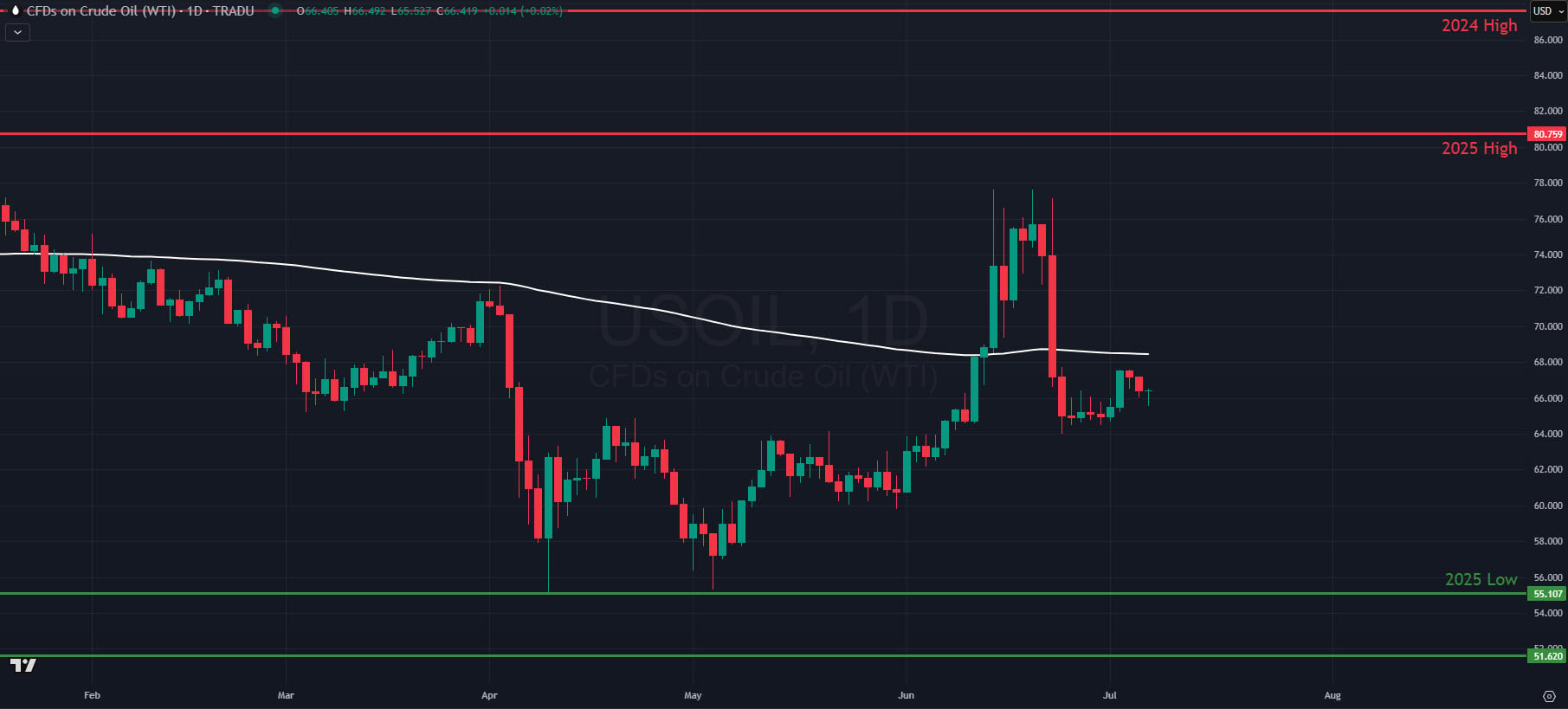
On the other hand, geopolitical tensions remain high and could reintroduce supply-side risks. The status of Iran’s nuclear programme remains uncertain, casting doubt on the longevity of the Israel-Iran ceasefire, while the war in Ukraine continues to pose risks. Reflecting growing security concerns, NATO recently committed to boosting defence spending to 5% of GDP [7].
Furthermore, OPEC+ may be hiking output, but low compliance lowers the real impact. Additional increases may be harder with over 85% of the intended hikes delivered and negative economic impact to producers form lower oil prices.
Trump’s commitment to drilling may play into oversupply fears but could also slow the global transition to renewable energy, thereby sustaining oil demand. Crucially, US officials like Treasury Secretary Scott Bessent floated a later date of August 1 for the implementation of higher tariffs, creating hopes for trade agreements that could alleviate the negative economic impacts. Both the US and Chinese economy show resiliency and a less severe impact than feared could be supportive of oil demand and prices. That could facilitate a new rebound in oil prices towards its 2025 peak, but sustained strength looks hard in the current environment.
Senior Financial Editorial Writer
Nikos Tzabouras
Nikos Tzabouras is a graduate of the Department of International & European Economic Studies at the Athens University of Economics and Business. With extensive experience in market analysis and a strong foundation in international relations, he brings a unique perspective to financial markets. Nikos emphasizes not only technical analysis but also on fundamentals and the growing influence of geopolitics on financial trends.
As a Senior Financial Editorial Writer, he delivers comprehensive and forward-looking insights across a wide range of asset classes, including equities, commodities, and currencies. His work explores how macroeconomic events, political developments, and global policies impact market dynamics, providing readers with a deeper understanding of both short-term movements and long-term trends.