
Shares
Rising Yields and Tariffs Threaten Bonds, Stocks, Stability

Bond yields have surged, with the 10-year at 4.36%, reflecting rising inflation expectations and weakening demand for Treasuries amid tariff uncertainty. This challenges the safe-haven appeal of bonds and adds pressure to equities, especially for debt-laden firms. With the Fed staying cautious and foreign holders possibly retreating, markets face a period of elevated volatility.
The bond market is currently experiencing heightened volatility, with yields on the 10-year Treasury reaching 4.36%—a level that has increased by 9.15% since the beginning of the week. This surge in yields is signalling not only a shift in market sentiment but also an increased risk for both bonds and equities alike. As yields rise and bond prices fall, the traditional safe-haven status of bonds is being called into question, with investors seeking refuge elsewhere. This dynamic is further complicated by the imposition of tariffs and the broader economic uncertainties they bring. As we delve into the factors driving these market movements, it becomes clear that the challenges posed by rising yields extend beyond the bond market, potentially influencing stock market performance and broader economic stability.
Yields on the 10-year Treasury currently stand at 4.36%. Moreover, they have increased by 9.15% since Monday. The yield has surpassed its 50-day EMA, and the RSI has risen above 50. The longer it remains above 50, the greater the pressure on higher rates, increasing the likelihood of the 50-day EMA adopting a positive slope. In summary, yields remain stubbornly high.
Typically, rising yields suggest that bond prices are falling. Therefore, bonds as a potential safe haven are not offering much cover against the current stock market carnage.
The imposition of tariffs by the Trump administration now appears to be fuelling inflation expectations, which in turn are pushing yields higher. A reason here may be a lack of substitutes for goods coming out of China. This is negative for the stock market, as it suggests that yields may remain elevated, potentially placing additional strain on companies with debt on their balance sheets.
This, in turn, will keep stock market participants wary and may hinder a broader recovery in equities. Another headwind is that the Federal Reserve is closely monitoring how the imposition of tariffs unfolds and appears in no rush to cut interest rates—or if it does, any cuts may be modest. This suggests the 'Fed put' may not be immediately triggered to support the stock market.
At face value, demand for US Treasuries appears to be weakening, particularly at the long end of the curve, in light of the 104% tariff on Chinese imports. Capital may be flowing out in anticipation of further complexities in the trade war, with investors retreating from US assets, including traditional safe havens.
The iShares 7-10 year Treasury Bond (IEF) ETF makes for an interesting analysis:

Source: www.tradingview.com
The ETF is down nearly 1.7% for the week on heavy selling volume (red arrow). It has yet to drop below its 50-day EMA, but if it does, that would signal further weakness in US Treasuries. IEF’s RSI is on the verge of falling below 50 (white arrow) (currently at 49.79). A reading below 50 indicates bearish momentum, and if it stays below this level, a break beneath the 50-day EMA would become more likely, with the EMA beginning to slope downwards.
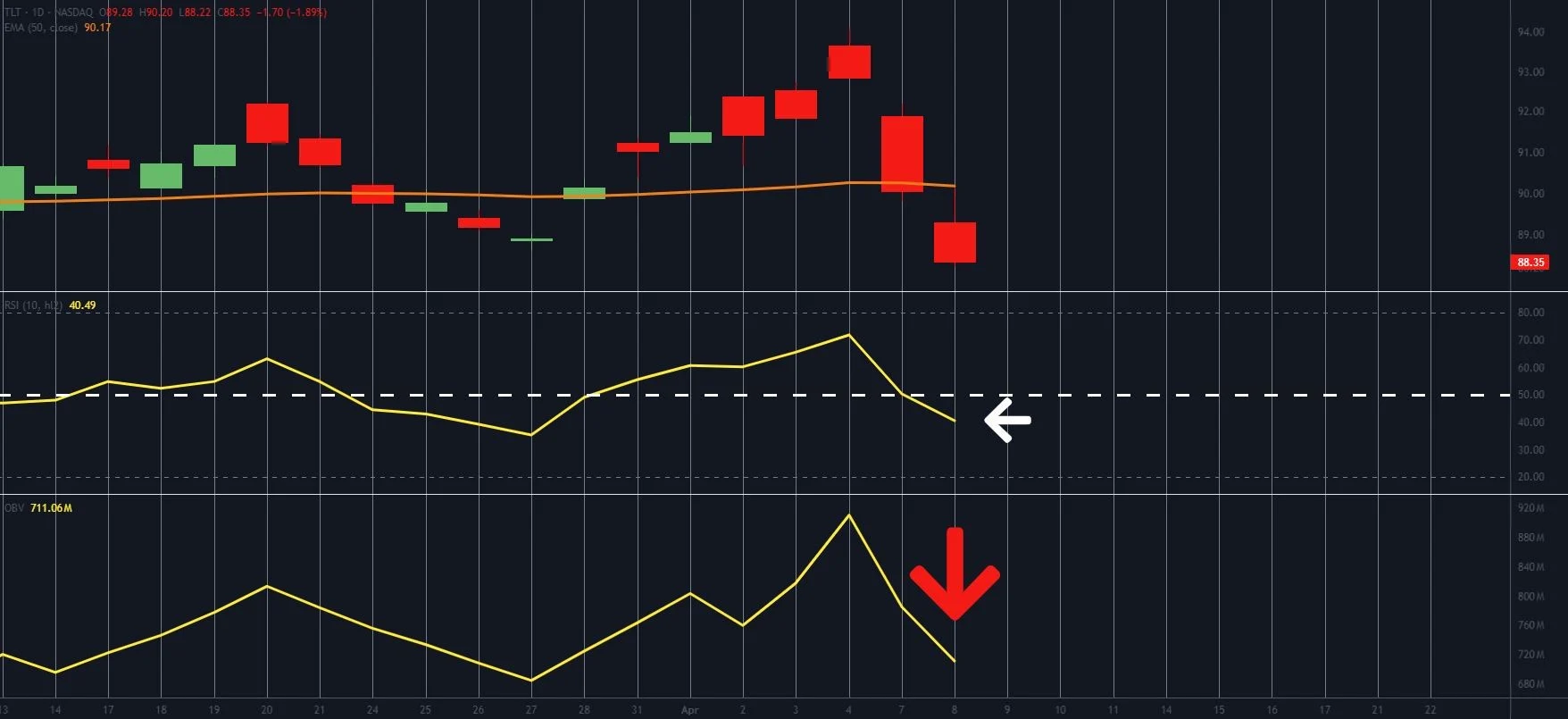
However, as we move further out on the curve, bearish sentiment increases, and investor distribution becomes more apparent. The iShares 20+ Year Treasury Bond ETF (TLT) shows increasing weakness when compared to IEF.
Source: www.tradingview.com
TLT has fallen significantly, down 4.85% this week on heavy volume (red arrow). It is now below its 50-day EMA (white arrow), with the EMA starting to roll over. Of concern, its RSI has dropped below 50 (white arrow), indicating underlying negative momentum. The longer the RSI remains below 50, the greater the pressure TLT will face.
The significant drop in TLT suggests that mortgage rates have risen, effectively reversing much of the positive gains made this year. This, in turn, will dampen disposable income, with consumer sentiment taking a hit largely due to tariff uncertainty.
Moreover, there may be a more concerning underlying reason for the substantial sell-off in the bond market. There could be growing concerns that Chinese and other international fixed-income holders are preparing to sell their holdings. If that’s the case, it would increase the supply of bonds, putting additional pressure on prices and pushing yields even higher.
In conclusion, the current dynamics in the bond market—marked by rising yields, weakening demand for Treasuries, and tariff-induced inflation expectations—suggest a period of heightened uncertainty ahead. With yields stubbornly high and the traditional refuge of bonds offering limited protection, both the stock market and broader economic conditions face significant pressure. The Federal Reserve’s cautious stance and the potential for increased bond supply from foreign holders only add to the challenges. As this complex situation unfolds, investors must navigate a delicate balance, where the impact of rising rates could reverberate across both debt and equity markets, shaping the financial landscape for months to come.
Senior Market Specialist
Russell Shor
Russell Shor is a Senior Market Strategist at Tradu, having been promoted to the role in 2025 in recognition of his depth of insight and consistent delivery of high-impact market analysis. He originally joined FXCM in October 2017 as a Senior Market Specialist.
Russell holds an Honours Degree in Economics from the University of South Africa, is a certified FMVA®, and a full member of the Society of Technical Analysts (UK). With over 20 years of experience in financial markets, his work is renowned for its clarity, precision, and strategic value across asset classes.